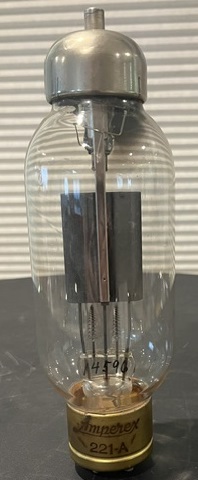
The Amperex 221-A is a large, high-power mercury-vapor rectifier vacuum tube, standing approximately 9 inches tall. It was a workhorse in industrial and broadcast applications during the mid-20th century. In the MicroBasement, this imposing tube represents the era of high-voltage vacuum tube power supplies, when massive glass envelopes handled kilowatts of power. This write-up covers the history of Amperex, the 221-A tube's function, specifications, time period of use, and its distinctive internal serial number feature.
Amperex Electronic Corporation was founded in 1922 in Brooklyn, New York, and became one of America's premier manufacturers of vacuum tubes, especially high-power transmitting and industrial types. In the 1930s-1950s, Amperex specialized in power tubes for radio broadcasting, radar, and medical equipment. The company was later acquired by North American Philips (Philips USA) in the 1950s, continuing production under the Amperex brand. Amperex tubes were known for rugged construction and high performance, often used in demanding military and commercial applications. The company eventually shifted to semiconductors in the 1970s-1980s as vacuum tube technology declined.
The 221-A is a mercury-vapor rectifier tube designed for high-voltage, high-current power supply applications. It is a single-anode, gas-filled rectifier that uses mercury vapor to achieve low forward voltage drop and high current capacity. A distinctive feature of many 221-A tubes is that the serial number is handwritten or etched directly inside the glass envelope - a quality control mark from the factory to track individual tubes during manufacturing and testing.
The 221-A was primarily used as a high-power rectifier in power supplies, converting high-voltage AC to DC. Key specifications include:
Because it used mercury vapor, the tube had to be operated vertically and allowed to warm up for several minutes before applying plate voltage to vaporize the mercury properly.
The 221-A was produced and widely used from the late 1940s through the 1960s. It was common in high-power broadcast transmitters, industrial X-ray machines, radar power supplies, and large laboratory equipment. By the 1970s, solid-state silicon rectifiers largely replaced mercury-vapor tubes due to smaller size, no warm-up time, and no toxic mercury hazard.
The Amperex 221-A is a classic example of the massive vacuum tubes that powered the golden age of electronics. Its size and internal serial number make it a striking display piece. In the MicroBasement, it serves as a reminder of the raw power and engineering scale of mid-20th century technology - when a single tube could handle voltages and currents that today would require banks of semiconductors.