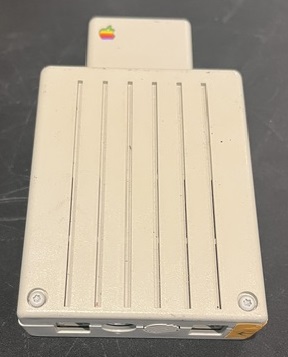
Apple Personal Modem
The Apple Personal Modem, released in 1987, was Apple's first branded modem, a compact external 300/1200 baud device designed for the Macintosh and Apple II lines. It provided reliable data communications for early online services, BBSs, and file transfers. In the MicroBasement, it represents Apple's entry into modem peripherals during the transition from Apple II to Macintosh dominance. This write-up covers its history, specifications, intended computers, features, software, and legacy.
History
Apple introduced the Personal Modem in 1987, capitalizing on the growing need for online connectivity in the Macintosh era. Priced at $299, it was positioned as an affordable, Apple-branded solution for users of services like CompuServe, GEnie, and early BBSs. The modem was part of Apple's push to make the Macintosh more versatile, following the 1984 Macintosh launch and the 1985 Macintosh Plus. It was sold until the early 1990s, when faster modems (2400 baud and above) and Apple's shift to higher-speed models (e.g., AppleFax Modem) made it obsolete.
Intended Computers in the Apple Line
The Personal Modem was designed primarily for the Macintosh family but also supported Apple II computers:
- Macintosh (Primary): Macintosh SE, SE/30, Macintosh II, Classic, and later models with serial ports (8-pin mini DIN). It plugged directly into the Mac's modem port.
- Apple II (Secondary): Apple IIe, IIc, IIgs, and IIc Plus via serial port. Pre-1985 Apple IIc models required a logic board upgrade for full compatibility.
- Not Intended For: Apple I, Lisa, or early Apple II models without serial expansion.
Its versatility made it popular across Apple's personal computer lineup in the late 1980s.
Specifications
The Apple Personal Modem had these key specs:
- Speed: 300/1200 baud (Bell 103/212A compatible; automatic fallback to 300)
- Interface: RS-232 serial (Apple 8-pin mini DIN or DB-25 with adapter)
- Connection: Direct-connect RJ11 to phone line
- Features: Hayes AT command set compatibility; auto-dial, auto-answer, redial; speaker for monitoring; LED indicators for carrier detect, data flow, and power
- Power: External "wall-wart" AC adapter (12V DC)
- Size: Compact handheld design (approx. 6" x 4" x 1.5") in Apple's Snow White aesthetic (beige, rounded edges)
- Price: $299 (1987 retail)
It was fully Hayes-compatible, requiring no special drivers on supported systems.
Features
The Personal Modem offered these key features:
- Hayes AT command compatibility for software control (e.g., ATDT for dial)
- Built-in speaker to hear dial tones and handshakes
- LED indicators for status (carrier detect, data flow, power)
- Automatic speed negotiation (1200 baud fallback to 300)
- Direct connect (no acoustic coupler needed)
- Compact, Apple-branded design matching Macintosh aesthetics
- Support for basic online services (CompuServe, The Source) and file transfers
It was simple, reliable, and cost-effective for Apple users in the late 1980s.
Software Used with the Personal Modem
The modem was Hayes-compatible, so it worked with most terminal programs on Apple systems. No special drivers were required - just set the serial port to 300 or 1200 baud, 8-N-1.
For Macintosh (Primary Use)
- MacTerminal: Apple's official terminal app (bundled with Mac OS); supported dialing, file transfers (XMODEM), and online services.
- ZTerm: Popular shareware terminal emulator; excellent for BBS, CompuServe, and file transfers (Kermit/ZMODEM).
- ClarisWorks Terminal Module: Integrated in ClarisWorks; simple for beginners on Macintosh SE/FDHD.
- White Knight: Commercial software with scripting and auto-logins for services.
- Microphone II: Advanced terminal with voice/data switching.
- Other: Red Ryder, FreeTerm - 1980s Mac comms apps for Hayes modems.
For Apple II (Secondary Compatibility)
- ProTERM: Shareware; best for Apple II; supported XMODEM/ZMODEM, scripting, and BBS navigation.
- Z-Term: Apple II version; simple terminal for 300/1200 baud.
- AppleWorks Communications Module: Integrated in AppleWorks; basic dialing and text.
- Kermit: Free for file transfers over noisy lines.
- With CP/M (Z-80 card): MODEM7 or IMP for advanced transfers.
Software was loaded from floppy disks, enabling BBS logins, file transfers, and online services at 300/1200 baud.
Legacy
The Apple Personal Modem bridged the Apple II and Macintosh eras, bringing affordable online access to thousands of users. It helped popularize modem use in education, gaming, and business. While overshadowed by faster third-party modems (e.g., Hayes Smartmodem), it was a reliable, Apple-branded solution. In the MicroBasement, it showcases Apple's push into communications during the late 1980s computing boom.
Back to Collection
Copyright 2026 - MicroBasement