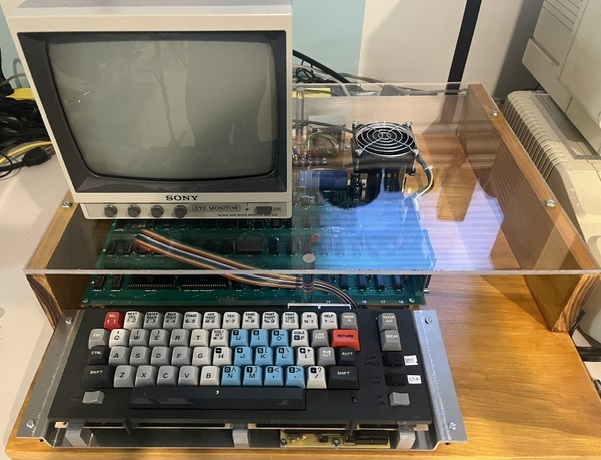
The Apple I, introduced in July 1976, was the first product ever released by Apple Computer. Designed largely as a fully assembled circuit board rather than a complete computer, it holds the distinction of being one of the first pre-assembled personal microcomputers sold to hobbyists, marking the beginning of what would become one of the most influential companies in computing history.
The Apple I was designed and hand-built by Steve Wozniak, with crucial marketing and business insight from Steve Jobs. Wozniak, an engineering genius and member of the Homebrew Computer Club, created the machine to impress his fellow hobbyists. Jobs saw its commercial potential and convinced Wozniak to sell it as a product. Together, they founded Apple Computer Company on April 1, 1976, to produce and market the board.
Wozniak began designing the Apple I in late 1975, inspired by his desire for a more elegant and efficient computer than the Altair 8800. Using the inexpensive MOS 6502 microprocessor, he achieved a remarkably compact and capable design. The first units were demonstrated at the Homebrew Computer Club in early 1976. Jobs secured an order for 50 units from Paul Terrell of the Byte Shop in Mountain View, California, on the condition they be fully assembled. Priced at $666.66 (a number Jobs reportedly liked for its repeating digits), approximately 200 Apple I boards were produced between 1976 and 1977.
The Apple I consisted of a single printed circuit board with no case, keyboard, monitor, or power supply included. Key features included:
Users typically housed the board in a wooden case, added a power supply, keyboard, and monitor to make a complete system.
The built-in monitor allowed hexadecimal program entry and execution. Wozniak later wrote Integer BASIC (distributed on cassette or paper tape), which became standard for users. Programs were entered via keyboard and displayed directly on a connected monitor—no front-panel switches or LEDs were needed.
Though sold in limited numbers and quickly superseded by the far more successful Apple II in 1977, the Apple I proved that a market existed for pre-assembled personal computers. Its profits funded development of the Apple II, launching Apple into prominence. Today, surviving Apple I units (around 60-70 known to exist) are extremely rare and valuable, often fetching hundreds of thousands to over a million dollars at auction. The Apple I remains an iconic symbol of the personal computer revolution and the garage-origin story of Apple Inc.