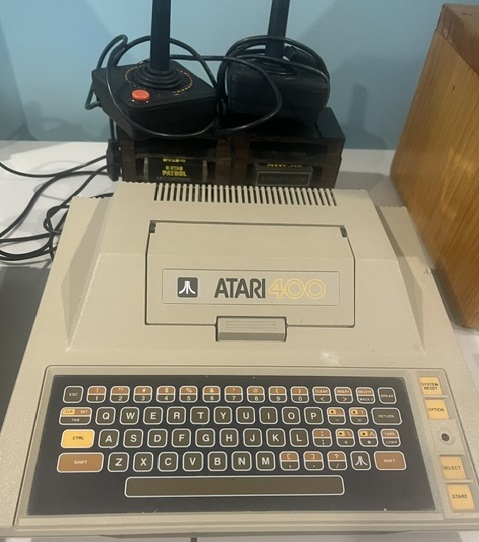
The Atari 400, released in November 1979, was Atari's entry-level home computer and part of the Atari 8-bit family. Designed for gaming and education, it featured advanced graphics and sound capabilities for its time, making it a strong competitor to the Apple II and Commodore PET. It was marketed alongside the more expensive Atari 800, which offered expandability, while the 400 was positioned as a more affordable, sealed unit for home users.
The Atari 400 and 800 were designed by a team led by Jay Miner (later creator of the Amiga) at Atari's Sunnyvale, California headquarters. The home-computer project was code-named Candy (400) and Colleen (800); Stella was the Atari 2600. The 400 was intentionally limited in expandability to keep costs down and differentiate it from the 800.
Announced in December 1979 at $549.99 (later reduced to $399), the Atari 400 shipped with 8 KB RAM (expandable to 48 KB via cartridge). It was bundled with Atari BASIC and sold over 1 million units across the 8-bit line. Production continued until 1985, when the XL series replaced it. The 400's membrane keyboard was criticized but its low price and strong software library made it popular.
The Atari 400 used the MOS Technology 6502 microprocessor. Key features included:
Compact beige case with built-in RF modulator for TV output.
Atari BASIC in ROM allowed immediate programming. The custom chipset (ANTIC for display lists, GTIA/POKEY for graphics/sound) enabled arcade-quality games like Star Raiders, Missile Command, and Centipede. Over 1,000 titles were released, including educational software and productivity tools. The SIO bus allowed easy peripheral chaining (disks, printers, modems). Later OS revisions improved compatibility.
The Atari 400 helped popularize home computing and gaming, introducing millions to sprites, smooth scrolling, and multichannel sound. It dominated arcades-to-home ports and education markets. Despite the membrane keyboard, its performance rivaled more expensive machines. The 8-bit line influenced the Atari ST and modern retro computing. Today, Atari 400s are collectible, with active communities maintaining emulators (Atari800), FPGA recreations, and hardware upgrades (e.g., Rapidus accelerator, SIDE cartridge). The Atari 400 remains a beloved icon of the 8-bit era.