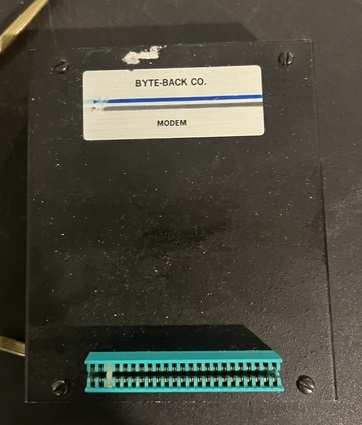
The Byte Back MD-1 modem was a 300 baud direct-connect modem designed for the Sinclair ZX81 (and Timex/Sinclair 1000), released in the early 1980s by Byte-Back Co. This obscure peripheral allowed ZX81 users to connect to phone lines for data communications, including BBS access and printing via an integrated RS-232 port. In the MicroBasement, it highlights the creativity of third-party add-ons for early home computers. This write-up covers the company's history, modem specs, significance for the ZX81, terminal software, and legacy.
Byte-Back Co was a US-based company (California) specializing in peripherals for Sinclair and Timex computers in the early 1980s. Founded during the ZX81 boom, it focused on affordable expansions like modems and interfaces. Byte-Back's products targeted hobbyists, filling gaps in Sinclair's minimalistic designs. The company was short-lived but contributed to the ZX81 ecosystem before fading as 8-bit computers evolved.
The MD-1 was a compact direct-connect modem with these key specs:
It was one of the first modems for the ZX81, enabling online access without expensive alternatives.
The ZX81 (1981) was a budget home computer with 1KB RAM, lacking built-in serial ports or modems. The MD-1 expanded its capabilities for communications, making it useful for BBS, data transfer, and printing. In the early 1980s, when acoustic couplers were common, the MD-1's direct-connect design was innovative, reducing noise and improving reliability. It helped ZX81 users join the growing online community, despite the computer's limitations.
The MD-1 included terminal software on cassette tape, a BASIC program for dialing, connecting, and basic communications. It supported manual dialing and simple terminal emulation. Popular third-party software included:
Software was loaded from cassette, enabling BBS logins and data exchange at 300 baud.
The Byte Back MD-1 was an obscure but important add-on, bringing modem functionality to the ZX81 at low cost. It highlighted third-party innovation for budget computers. While replaced by faster modems, it paved the way for online hobbies. In the MicroBasement, it shows how peripherals like this transformed simple machines into communication devices.