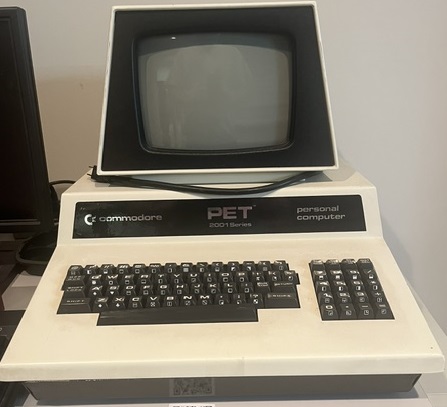
The Commodore PET 2001, introduced in January 1977 at the Winter CES, was one of the "1977 Trinity" of fully assembled personal computers (alongside the Apple II and TRS-80 Model I). It was the first complete, all-in-one computer from Commodore and helped establish the company as a major player in the emerging personal computer market.
Designed by a team led by Chuck Peddle, the former MOS Technology engineer who created the 6502 microprocessor. After Commodore acquired MOS in 1976, Peddle convinced Jack Tramiel to enter the personal computer market. The PET (Personal Electronic Transactor) was conceived as a self-contained, business-oriented machine with integrated keyboard and display.
Announced in January 1977 and shipped in late 1977 (initially as the PET 2001-8 with 8 KB RAM, later 2001-16 and 2001-32 variants). Priced at $795 for the 8 KB model, it targeted schools, small businesses, and hobbyists. Early units featured the distinctive "chiclet" keyboard and built-in monochrome monitor. Production of the original 2001 series continued until 1980, when it was replaced by redesigned models with full-size keyboards.
The PET 2001 used the MOS Technology 6502 microprocessor. Key features included:
The all-metal case housed the motherboard, monitor, and power supply - earning it the nickname "the lunchbox."
Microsoft BASIC 1.0 (later 2.0 and 4.0 upgrades) was built into ROM, providing immediate programming capability. Thousands of educational, business, and game programs emerged on tape, including early hits like Star Trek and business software. The IEEE-488 bus allowed easy connection of professional peripherals, making it popular in schools and labs.
The PET 2001 proved that complete, ready-to-use computers could sell successfully, influencing the industry toward integrated designs. It dominated educational markets in many countries (especially Canada and Europe) and introduced countless students to programming. Despite quirks like the chiclet keyboard and limited graphics, its reliability and expandability earned loyalty. The PET line evolved into the CBM 4000/8000 series business machines. Today, original PET 2001s are prized collectibles, with active restoration and emulation communities preserving its place as a foundational machine of the personal computer era.