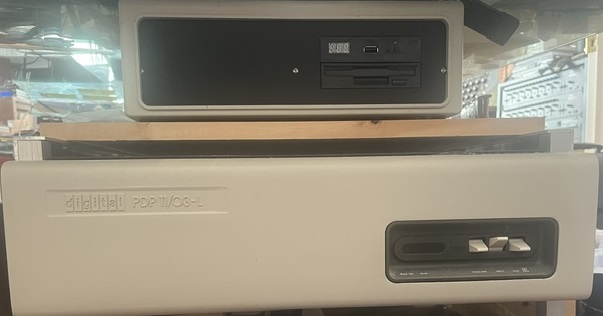
The DEC PDP-11/83, part of the MicroPDP-11 series, was a high-performance Q-bus minicomputer introduced in the mid-1980s. It represented one of the fastest and most advanced implementations of the legendary PDP-11 architecture, offering enhanced speed and memory capabilities for scientific, engineering, and multi-user applications during the twilight years of the PDP-11 line.
The PDP-11/83 was developed by Digital Equipment Corporation (DEC), the company that created the entire PDP-11 family starting in 1970. The specific CPU board (KDJ11-B) used the in-house designed J-11 chipset (also known as DCJ-11 or "Jaws-11"), a VLSI microprocessor implementation of the PDP-11 instruction set. DEC's engineering teams refined the PDP-11 over nearly two decades, with the later Q-bus models like the /83 showcasing advanced integration and performance optimizations.
Introduced around 1985 as part of the MicroPDP-11 lineup, the PDP-11/83 built on earlier J-11 based systems like the PDP-11/73. It featured the faster KDJ11-B CPU running at 18 MHz and support for Private Memory Interconnect (PMI) for high-speed memory access. Marketed in enclosures like the BA23 or BA123, it targeted users needing maximum PDP-11 performance while maintaining compatibility with existing software and peripherals. Production continued into the late 1980s, with the similar PDP-11/93 as one of the final models before DEC phased out the line in favor of VAX and other systems.
The PDP-11/83 used the KDJ11-B quad-height CPU board with the J-11 chipset. Key features included:
The system supported standard PDP-11 peripherals like RQDX3 floppy/hard disk controllers, TK50 tapes, and multi-line serial boards.
The PDP-11/83 ran all major PDP-11 operating systems, including RT-11, RSX-11M/M-Plus, RSTS/E, and UNIX variants (2.9BSD, 2.11BSD). Its high speed and large memory made it ideal for multi-user timesharing and real-time applications. Built-in diagnostics, battery-backed clock, and extensive self-test features enhanced reliability.
The PDP-11/83 delivered peak performance for the PDP-11 architecture, extending its viability into the late 1980s against emerging microcomputers and workstations. It served in laboratories, industry, and education, benefiting from the vast PDP-11 software ecosystem. As one of the last high-end PDP-11 models, it symbolized the end of an era for DEC's iconic 16-bit minicomputer line, which influenced operating systems like UNIX and countless engineers. Surviving PDP-11/83 systems are prized by retro-computing enthusiasts and preserved in museums.