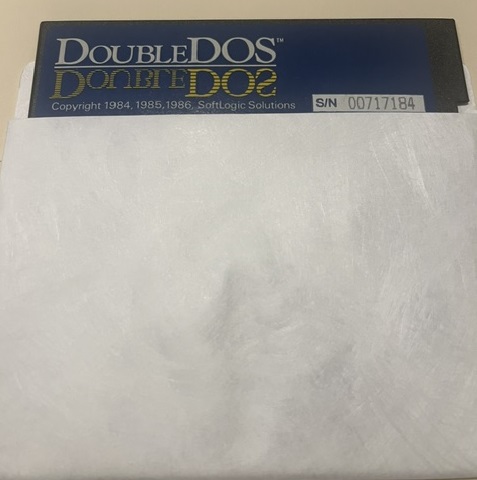
DoubleDOS was a groundbreaking multitasking utility for MS-DOS, allowing users to run two programs simultaneously on a system that was otherwise single-tasking. Developed by SoftLogic Solutions in the mid-1980s, it was one of the first solutions to bring limited multitasking to personal computers. In the MicroBasement, DoubleDOS represents the clever software hacks that extended the life of DOS before full multitasking OSes like Windows arrived. This write-up covers the origins of SoftLogic Solutions, how DoubleDOS worked, its release, cost, obsolescence, company history, other products, and its use.
SoftLogic Solutions was founded in the early 1980s in Manchester, New Hampshire (with offices in Salem, N.H.). The company focused on productivity software and utilities for MS-DOS, aiming to enhance the capabilities of early personal computers. SoftLogic was known for innovative tools that addressed limitations in DOS, such as single-tasking. The company operated through the 1980s but faded in the 1990s as multitasking became standard in new OSes like Windows 3.1 and OS/2.
MS-DOS was designed to run one program at a time, forcing users to exit applications to switch tasks. DoubleDOS overcame this by partitioning memory and swapping between two programs. Unlike modern multitasking with multiple visible windows, DoubleDOS ran one program in the foreground at a time - the user switched between them with a hotkey. It was compatible with most DOS programs but worked best with non-processor-intensive apps. TSR (Terminate and Stay Resident) programs were common for utilities, but DoubleDOS went further: two full sessions time-sliced in separate memory partitions, not just a popup calculator.
DoubleDOS was announced in 1984 and released shortly after. Initial price was $299 (around $900 in 2026 dollars), later dropping to $49.95 by 1987 as competition grew. Sales figures aren't publicly available, but it was popular among power users and businesses; estimates suggest thousands of copies sold by the late 1980s. SoftLogic removed copy protection in later versions to boost appeal.
DoubleDOS became obsolete by the early 1990s as multitasking OSes emerged. Windows 3.0 (1990) and OS/2 (1987) allowed multiple programs to run simultaneously with true windowing. By Windows 95 (1995), DOS utilities like DoubleDOS were unnecessary. The shift to graphical interfaces and protected memory made memory-swapping hacks irrelevant.
SoftLogic Solutions specialized in DOS productivity tools. Other products included Disk Optimizer (defragmentation utility) and various file management software. The company was active through the 1980s but struggled in the 1990s as Windows dominated. SoftLogic was eventually acquired or dissolved; little public info exists on its final years.
DoubleDOS was used by business users, programmers, and hobbyists to run utilities alongside main applications (e.g., a calculator while in a spreadsheet). It extended DOS's lifespan for power users but highlighted the need for true multitasking. While not as famous as DESQview or Windows, it paved the way for more advanced solutions and showed the creativity of early PC software developers.
DoubleDOS is a snapshot of the DOS era's limitations and ingenuity. It foreshadowed the multitasking world we take for granted today. In the MicroBasement, it reminds us how software hacks like this pushed hardware boundaries until better OSes arrived - a testament to the resourcefulness of early PC enthusiasts.