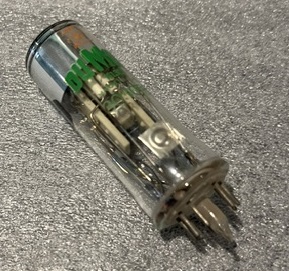
The DuMont K1303 is a ruggedized 6-stage photomultiplier tube (PMT), one of the most reliable and compact high-gain light detectors of the 1950s. Developed for military and industrial use, it amplified extremely faint light signals into strong electrical pulses. In the MicroBasement, the K1303 is a beautiful example of vacuum tube precision engineering - a small, tough PMT that bridged early computing, radiation detection, and scientific instrumentation. This write-up covers the history of DuMont, the K1303 tube, its function, specifications, time period of use, and legacy.
Allen B. DuMont Laboratories was founded by Allen B. DuMont in 1931 in Upper Montclair, New Jersey. DuMont was a pioneer in cathode ray tubes (CRTs) and television technology, developing the first practical TV picture tubes in the 1930s. During WWII, DuMont produced radar and military electronics. Post-war, DuMont became one of the leading U.S. television manufacturers and broadcasters (DuMont Television Network, 1946-1956). The company was also renowned for high-quality photomultiplier tubes and other special-purpose tubes. DuMont was acquired by Emerson Radio in 1958, and tube production ended in the 1960s as solid-state technology advanced.
The K1303 is a 6-stage photomultiplier tube with a ruggedized construction (reinforced envelope and leads) for use in high-vibration and shock environments. It was a direct descendant of the DuMont 6365 PMT but optimized for mechanical durability. The tube is compact, with a clear glass envelope, flying leads for direct soldering or socket mounting, and a side-viewing window. It was part of DuMont's line of PMTs used in early digital systems and scientific instruments.
The K1303 converts photons into electrons at a photocathode, then multiplies those electrons through a series of dynodes to produce a strong electrical pulse. Key specifications include:
It was prized for its high gain in a small, durable package, suitable for detecting low-level light in harsh conditions.
The K1303 was produced and widely used from the early 1950s through the 1960s. It was common in military applications (e.g., SAGE air defense system light guns for radar operator input), scintillation counters for radiation detection, density/moisture measurement instruments, and early scientific computing. Production continued into the 1970s for replacement parts, but it was largely replaced by solid-state photodiodes and improved PMTs in the late 1960s.
The DuMont K1303 is a rare and collectible tube today, valued for its role in early computing (SAGE system) and scientific detection. Surviving examples sell for $20-$100 in the collector market. In the MicroBasement, it stands as a testament to DuMont's engineering excellence - a small, rugged photomultiplier that helped bridge vacuum tube and solid-state eras in light detection and instrumentation.