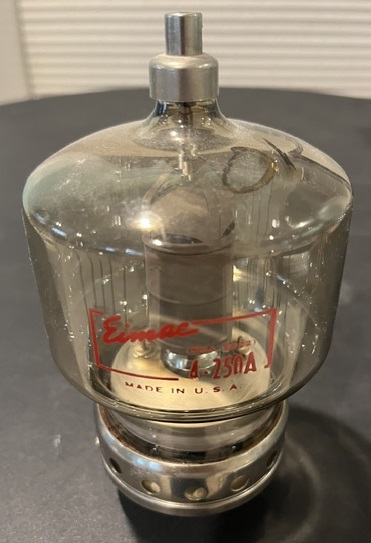
The Eimac 4-250A is a classic high-power transmitting tetrode vacuum tube, widely used in amateur radio, commercial broadcasting, and industrial RF applications from the 1940s through the 1980s. Known for its rugged construction, high plate dissipation, and excellent linearity, it was a workhorse for HF amplifiers and modulators. In the MicroBasement, the 4-250A represents the golden age of high-power tube RF - a tube that could deliver kilowatts of output with reliability and style. This write-up covers the tube's history, function, specifications, typical use, and legacy.
Eimac (Eitel-McCullough, Inc.) was founded in 1934 by Bill Eitel and Jack McCullough in San Bruno, California. They specialized in high-power transmitting tubes for radio broadcasting, amateur radio, and military use. The 4-250A was introduced in the late 1940s as an improved version of earlier 250-watt tetrodes (like the 4-125A). It became a standard in ham amplifiers, broadcast transmitters, and linear service through the 1970s. Eimac was acquired by Varian Associates in 1965, and tube production continued into the 1990s. Today, NOS (new old stock) 4-250As are prized by collectors and restorers.
The 4-250A is a beam power tetrode designed for RF power amplification, modulation, and oscillator service. It features a thoriated-tungsten filament for long life and low heater power, and a high plate dissipation rating. Key specifications include:
It was prized for its high gain, good linearity in linear amplifiers, and rugged construction.
The 4-250A was widely used in:
It was often paired in push-pull configurations for higher power or used singly in medium-power rigs. Many classic ham amplifiers (e.g., homebrew or commercial like the Henry 2K) relied on pairs of 4-250As.
The Eimac 4-250A is one of the most revered transmitting tubes among vintage radio enthusiasts and restorers. Its combination of power, linearity, and reliability made it a favorite for decades. Today, NOS tubes command high prices ($200-$500 each in good condition), and working amplifiers using 4-250As are still in use by hams worldwide. In the MicroBasement, it stands as a testament to the golden age of high-power tube RF - a tube that could push kilowatts across continents with nothing more than a few watts of drive and a good antenna.