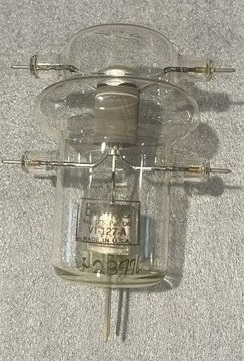
The Eimac VT-127A is a high-power triode vacuum tube developed during World War II for military communications and radar systems. Known for its rugged design and high output (maximum plate dissipation of 100 watts), it became a staple in surplus markets after the war, finding new life among amateur radio enthusiasts. In the MicroBasement, the VT-127A exemplifies wartime innovation repurposed for peacetime hobbies. This write-up covers the history of Eimac, the VT-127A tube, its original uses, the post-war surplus market, how surplus tubes were used, and its legacy.
Eimac was founded in 1934 by William Eitel and Jack McCullough in San Bruno, California. The name combines their last names: "Eitel-McCullough." Starting in a garage, they focused on vacuum tubes for radio transmitters, improving power and reliability. By the late 1930s, Eimac tubes were used in broadcast and amateur radio. During WWII, Eimac expanded rapidly, producing tubes for Allied radar and communications. Post-war, it led in microwave and power tubes. Acquired by Varian Associates in 1965, it became Eimac Division. In 1995, Varian's tube business was sold to Communications & Power Industries (CPI), where Eimac operates today as a brand for high-power RF tubes. Eimac's legacy is in advancing tube technology for broadcasting, defense, and science.
The VT-127A was developed by Eimac in the early 1940s as a high-power triode for wartime needs. It was part of the VT series (Vacuum Tube), standardized for military use. Production ramped up during WWII, with thousands manufactured for U.S. and Allied forces. The tube featured a thoriated tungsten filament for longevity and a graphite anode for heat dissipation. Post-war, surplus VT-127As flooded the market, sold cheaply to civilians. It remained in production variants through the 1950s for industrial use.
Originally, the VT-127A was used in high-power RF amplifiers for military communications, radar transmitters, and jamming equipment. Its 100W plate dissipation and 100 MHz frequency capability made it ideal for VHF/UHF systems in aircraft, ships, and ground stations. It amplified signals in pulse or continuous wave modes, critical for WWII operations like D-Day communications and Pacific radar networks.
After WWII ended in 1945, massive stockpiles of military electronics, including VT-127A tubes, were sold as surplus. Government auctions and surplus stores offered them for pennies on the dollar - often $5-$10 each (vs. $100+ new). This flood created a thriving surplus market in the late 1940s-1950s, where hobbyists and engineers scavenged for parts. Surplus VT-127As were abundant due to overproduction, fueling the post-war radio boom.
Surplus VT-127As were repurposed by amateur radio (ham) operators for high-power linear amplifiers, boosting signals for long-distance communication. Enthusiasts built "homebrew" rigs, often modifying the tube for 144 MHz (2-meter) or 50 MHz bands. They were also used in experimental TV transmitters, audio amplifiers, and industrial heaters. Ham magazines like QST featured VT-127A projects, with users overdriving them for 1kW+ output. This DIY culture helped democratize radio technology.
The VT-127A's legacy is in its role during WWII and the surplus era, enabling affordable access to high-power tech for hobbyists. It symbolized the shift from wartime to peacetime innovation. Eimac's designs influenced later tubes, but transistors displaced them by the 1960s. In the MicroBasement, the VT-127A highlights how surplus gear sparked the electronics hobby movement, paving the way for personal computing.