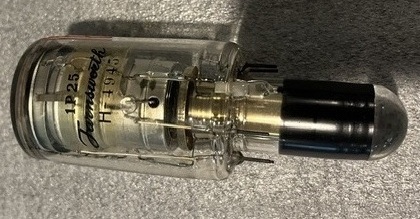
The Farnsworth 1P25 is a remarkable early image amplifier (image converter) vacuum tube developed during World War II. It was the heart of the first practical "see-in-the-dark" infrared viewing systems, allowing soldiers to detect enemies at night using invisible infrared illumination. In the MicroBasement, this tube is a standout piece of Cold War and WWII technology, representing the dawn of night vision. This write-up covers the history of Farnsworth, the 1P25 tube, its original military uses, civilian/hobbyist projects (including a notable construction article), cost, and what technologies eventually replaced it.
Farnsworth Television and Radio Corporation was founded by Philo T. Farnsworth, the inventor of electronic television, in 1927. After his pioneering work on TV in the 1920s-1930s, Farnsworth turned his attention to military applications during WWII. The company developed advanced vacuum tube technologies, including image orthicons and image converter tubes. In 1949, Farnsworth was acquired by ITT (International Telephone and Telegraph), and the tube division continued under the Farnsworth name. The company was known for high-quality military and scientific tubes. Philo Farnsworth himself remained involved in research until his death in 1971.
The 1P25 is an image converter tube that amplifies extremely faint infrared light into a visible green image. It works by converting incoming infrared photons into electrons at a photocathode, accelerating and focusing those electrons onto a phosphor screen, where they produce visible light. The tube is about 6-7 inches long with a 1-inch diameter faceplate. It requires high voltage (around 4,000-6,000 volts) and was typically paired with an infrared illuminator (a filtered spotlight) to "light up" the scene in total darkness.
The 1P25 was the core of the famous M2 "Snooperscope" and M3 "Sniperscope" used by U.S. forces in WWII and the Korean War. These were the world's first practical night vision devices. The Snooperscope was a handheld viewer for scouting, while the Sniperscope was mounted on a carbine rifle for night combat. They allowed soldiers to see enemy troops and vehicles in complete darkness using an infrared searchlight. The system was classified during the war and declassified in the late 1940s, leading to surplus availability.
After WWII, large numbers of 1P25 tubes appeared on the surplus market. A notable hobbyist construction project appeared in the August 1985 issue of Radio Electronics magazine. The article described building an infrared viewer using the 6032 image tube - a newer, more readily available tube at the time - but the concepts, circuit design, and high-voltage techniques are fundamentally the same as those required for the 1P25. These homebuilt devices were popular among amateur scientists, hunters, and electronics enthusiasts for night observation, wildlife viewing, and experimentation. Builders typically paired the tube with a simple high-voltage power supply and an infrared illuminator made from a flashlight and IR filter.
During WWII, the 1P25 was a classified military component with no public price. In the post-war surplus market of the 1950s-1960s, complete Snooperscope/Sniperscope units sold for $50-$150, while individual 1P25 tubes typically cost $15-$35 (roughly $150-$350 in 2026 dollars). By the 1970s, prices dropped further as surplus dried up.
The 1P25 was eventually replaced by more advanced image intensifier tubes (Generation 1, 2, and 3) in the 1960s-1970s. These offered much higher gain, better resolution, and no need for an active infrared illuminator (they amplified ambient starlight). Later, solid-state night vision based on CCD and CMOS sensors (1990s-2000s) made vacuum tube night vision largely obsolete for most applications, though military Gen 3 and digital systems continue to evolve.
The Farnsworth 1P25 was a groundbreaking device that brought practical night vision to the battlefield and then to civilian experimenters. It marked the beginning of image intensification technology that eventually led to modern night vision goggles and digital low-light cameras. In the MicroBasement, it stands as a rare and impressive example of early electronic "seeing in the dark" technology - a true marvel of mid-20th century engineering.