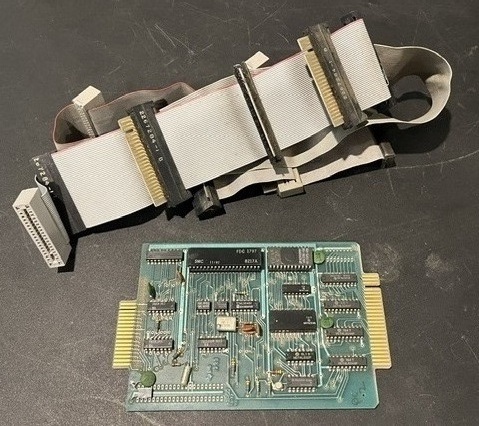
The FDZX Floppy Controller (also known as FD-ZX Floppy Disk Interface) was an obscure but innovative add-on for the Sinclair ZX81 computer, released in 1982 by AERCO. This peripheral allowed the ZX81 (and its US variant, the Timex/Sinclair 1000) to use floppy disk drives for storage, replacing slow cassette tapes with faster, more reliable mass storage. In the MicroBasement, it highlights third-party ingenuity in expanding budget computers. This write-up covers its history, manufacturer, specifications, price, features, how it works (including the WD1797 controller chip), software used, significance, and legacy.
The FDZX was developed and released in 1982 by AERCO, a US-based company specializing in peripherals for early home computers. It emerged during the ZX81's popularity boom (1981-1984), when users sought ways to overcome the machine's limitations, like cassette-only storage. AERCO targeted hobbyists and educators, providing affordable expansions. The FDZX was one of the first floppy interfaces for the ZX81, filling a gap in Sinclair's minimal ecosystem before official Timex FDD systems in 1984.
The FDZX was a compact interface card with these key specs:
It included an EPROM with software drivers, making it a complete solution for disk access.
The FDZX offered practical features for ZX81 users:
It transformed the ZX81 from a cassette-based toy into a more capable machine for programming and data storage.
The FDZX plugged into the ZX81's expansion port, providing a Western Digital WD1797 floppy disk controller chip (or compatible equivalent). The WD1797 is a single-chip floppy disk controller that handles low-level operations such as head stepping, track seeking, sector reading/writing, CRC checking, and data encoding/decoding. It interfaced the ZX81's Z80 CPU with standard floppy drives via a ribbon cable. The controller chip managed:
The FDZX's EPROM contained drivers that mapped disk commands to BASIC extensions, allowing LOAD/SAVE from floppy instead of tape. The WD1797 made the interface efficient and reliable for the era, supporting both single and double density formats.
The FDZX came with a built-in Disk Operating System (DOS) stored in EPROM, extending ZX81 BASIC with commands like LOAD "D:filename", SAVE "D:filename", and DIR for directory. This made disk access seamless. Third-party software, like enhanced terminals or utilities from magazines (e.g., Sinclair User), leveraged it for BBS access or data logging. Without additional OS, it ran directly in BASIC; with ZX81 expansions like RAM packs, it supported more complex programs.
The FDZX was significant for ZX81 owners, as the base machine had only 1KB RAM and slow cassette storage. It enabled faster, more reliable data handling, appealing to hobbyists and educators. In the early 1980s, when floppy drives were expensive luxuries, the FDZX made mass storage affordable ($179 + drive cost). It exemplified third-party expansions that kept the ZX81 relevant amid competitors like the Commodore 64.
The FDZX showcased early floppy interfaces for home computers, bridging cassettes to disks. Though obscure (limited production, mainly US market), it influenced later Timex FDD systems. In the MicroBasement, it demonstrates how add-ons like this empowered budget users, paving the way for modern storage. As an AERCO product, it's a rare artifact of 1980s peripheral innovation.