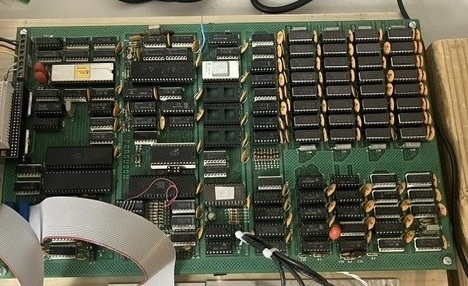
The Ferguson Big Board I, introduced in 1980, was a pioneering single-board microcomputer that brought a complete, affordable CP/M-compatible system to hobbyists and early enthusiasts. Often simply called the "Big Board" or "The Ferguson," it integrated nearly all necessary components onto one large printed circuit board, dramatically lowering the cost and complexity of building a powerful 8-bit computer.
The Big Board I was designed by Jim (J.B.) Ferguson, an electronics engineer who sought to create an inexpensive yet fully functional computer for running the popular CP/M operating system. Ferguson licensed the design to Digital Research Computers (of Texas), which sold it as bare PCBs, kits, or fully assembled boards. The simplicity and thorough documentation allowed even novices to successfully build and operate the system.
Released in 1980, the Big Board I was marketed through advertisements in magazines like Byte. Priced affordably (bare boards around $195, kits higher), it quickly gained a dedicated following. Its large PCB was deliberately sized to mount directly atop a Shugart 8-inch floppy disk drive, minimizing enclosure needs. The design influenced commercial products, including the Xerox 820, which licensed a version of the Big Board. A dedicated magazine, Micro Cornucopia, emerged to support users with software, modifications, and tips.
The Big Board I was built around the Zilog Z80 8-bit microprocessor. Key features included:
A complete system required only external power supplies, floppy drives, a video monitor, and keyboard (or serial terminal).
The board shipped with PFM-80, a ROM-based monitor program providing basic system control, disk boot, and debugging. It was optimized for CP/M 2.2, offering access to a vast library of business, programming, and utility software. Community upgrades included dual-density controllers, higher clock speeds, and expanded memory banking for RAM disks.
The Big Board I democratized access to serious computing in the early 1980s, enabling thousands of hobbyists to run professional-grade software at a fraction of commercial prices. Its success spawned the improved Big Board II in 1982 (with double-density disks, 4 MHz clock, and hard drive support) and influenced later CP/M machines like the Kaypro series. Surviving Big Board I systems are rare and highly valued by retro-computing collectors, representing a key milestone in the DIY single-board computer era.