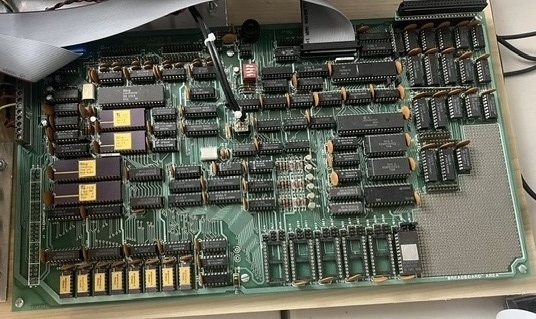
The Ferguson Big Board II, released in 1982, was the highly anticipated successor to the popular Big Board I. It retained the single-board, low-cost philosophy while adding significant improvements in speed, storage capacity, and features, making it one of the most capable and versatile CP/M systems available to hobbyists in the early 1980s.
Like its predecessor, the Big Board II was designed by Jim Ferguson and sold through Digital Research Computers (DRC) of Texas. Ferguson responded to user feedback and technological advances by creating a more powerful board that still prioritized affordability and ease of construction. Thorough documentation and community support continued to be hallmarks of the design.
Introduced in 1982, the Big Board II was advertised in Byte and other magazines alongside the original. Bare PCBs sold for around $295, with kits and assembled units higher. Thousands were produced, and the design again influenced commercial products. The board's larger size (approximately 10" x 14") allowed for added circuitry while still fitting common enclosures or mounting atop disk drives.
The Big Board II was built around the Zilog Z80A microprocessor. Key features included:
A complete system required only external power, disk drives, monitor, and keyboard.
The board shipped with PFM-80 II, an enhanced ROM monitor offering disk boot, memory test, and terminal emulation. It ran CP/M 2.2 out of the box and supported CP/M 3.0 (CP/M Plus) with banking for larger programs and RAM disks. The community developed extensive modifications, including turbo modes (up to 6 MHz), additional banking schemes, and graphics boards.
The Big Board II extended the life of Z80/CP/M computing into the mid-1980s, providing performance rivaling more expensive commercial systems like the Kaypro or Osborne at a fraction of the cost. Its expandability and active user base (supported by Micro Cornucopia magazine) kept it relevant longer than many contemporaries. The Big Board series as a whole demonstrated that powerful, professional-grade computing could be achieved through clever single-board design and community collaboration. Surviving Big Board II systems remain prized by retro-computing enthusiasts and are often restored or emulated today.