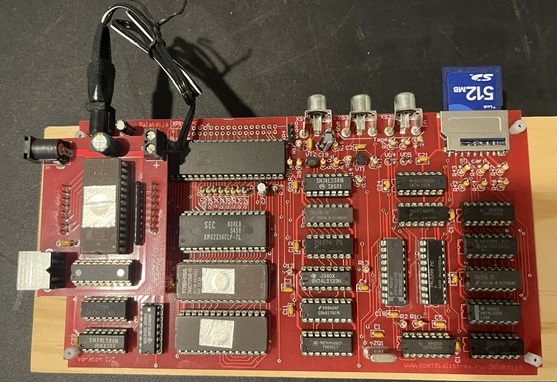
The Galaksija was a remarkable DIY microcomputer from Yugoslavia, designed in the early 1980s as a low-cost, build-it-yourself project for hobbyists. It became one of the most successful home computer kits in Eastern Europe, allowing thousands of people to enter the microcomputer era during a time when Western computers were expensive or unavailable. In the MicroBasement, the Galaksija is a modern replica electrically - built on a newly designed board and using a modern keyboard - while staying true to the original architecture and spirit. This write-up covers the history, creator, publication, architecture, chips, what was published to assist builders, estimated numbers built, software and storage, and its legacy.
The Galaksija was created by Voja Antonic (full name: Vojislav Antonic), a Serbian engineer, musician, and electronics enthusiast. In 1983, during a period when personal computers were rare and costly in Yugoslavia due to import restrictions and economic conditions, Antonic wanted to make computing accessible to ordinary people. He designed the Galaksija as a simple, inexpensive kit that could be built at home using locally available parts. The project was first published in Galaksija magazine (issue #1, December 1983), a popular Yugoslav electronics and computing magazine edited by Jova Regasek. The magazine printed the complete schematic, parts list, BASIC listing, and assembly instructions across several issues, making it one of the first fully documented DIY computer projects in Eastern Europe.
The Galaksija was built around a Zilog Z80A CPU running at 3.072 MHz (derived from a 6.144 MHz crystal). It had:
Key chips included the Z80A, 8255 PPI (for I/O), 8253 timer (for video timing), and a few 74LS series logic chips. The video was generated entirely in software — no dedicated video chip — which was a clever but CPU-intensive trick that made the machine extremely cheap.
Galaksija magazine published everything needed to build the computer:
Later issues included expansions (RAM, sound, joystick, printer interface) and software libraries. The magazine also printed user-submitted programs and modifications, creating a strong community around the project.
The Galaksija came with a built-in BASIC interpreter in ROM, written by Voja Antonic himself. This allowed users to write and run programs immediately after assembly. Hundreds of programs were written for it, including games (e.g., Space Invaders clones, chess, text adventures), utilities (editors, assemblers, file managers), educational software, and demos. The magazine published many of these as type-in listings, and users shared cassettes through clubs and mail. Storage was via audio cassette tape using a simple interface — programs were saved/loaded as audio tones at 300 baud. Users connected a standard cassette recorder to the machines audio in/out ports, recording programs as sound files on ordinary tapes. No floppy disks or hard drives were standard, though expansions added printer and joystick ports. The BASIC was compatible with Microsoft BASIC variants, allowing some ported software from other Z80 machines.
Exact numbers are not known, but estimates suggest 8,000 to 12,000 Galaksija computers were built, mostly in Yugoslavia (Serbia, Croatia, Bosnia, etc.). This made it one of the most successful DIY computers in Eastern Europe. Many were built from kits or home-assembled from magazine plans, with some later clones and variants produced in small numbers.
The Galaksija in the MicroBasement is a modern replica electrically faithful to the original. It uses a newly designed PCB for easier construction and reliability, and a modern keyboard replaces the original matrix. The core architecture, Z80 CPU, memory map, and software remain identical to Antonic's 1983 design, allowing period-correct software to run perfectly. This replica keeps the DIY spirit alive while making the machine practical for today's use and demonstration.
The Galaksija showed that a simple, low-cost computer could be built at home and still run useful software. It fostered a generation of Yugoslav programmers and engineers during difficult economic times. In the MicroBasement, it stands as a tribute to Voja Antonic’s ingenuity and the power of open, magazine-published designs - a reminder that computing can be accessible to anyone with curiosity and a soldering iron.