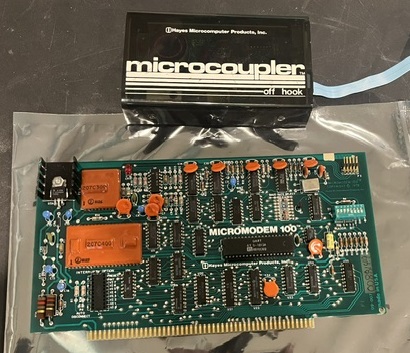
The Hayes Micromodem 100 was the first modem produced by Hayes Microcomputer Products in 1979, marking the beginning of a company that revolutionized data communications. This S-100 bus card enabled early microcomputers to connect directly to phone lines at 300 baud, eliminating the need for an acoustic coupler and paving the way for the "Hayes Standard" AT command set. In the MicroBasement, it represents the dawn of personal modem use. This write-up covers Hayes history, the Micromodem 100, the S-100 bus significance, terminal software used with/without OS like CP/M, and the direct-connect innovation that eliminated acoustic coupling.
Hayes Microcomputer Products was founded in 1977 by Dennis C. Hayes and Dale Heatherington in Atlanta, Georgia. Starting in a garage, they aimed to create affordable modems for the emerging microcomputer market. Hayes became synonymous with "Smartmodems," introducing the AT command set for software control. At its peak in the 1990s, Hayes dominated with 50%+ market share, but bankruptcy in 1999 followed the shift to broadband. The brand was revived through acquisitions, influencing modem standards still used today.
The Micromodem 100 was Hayes' debut product, a 300 baud modem card for the S-100 bus. Priced at $349, it included an RS-232 interface, on-board intelligence for dialing/answering, and direct-connect capability. It was "smart" - handling commands like dialing without CPU intervention. This innovation simplified software and set the stage for Hayes' dominance, evolving into external models like the Smartmodem 300 (1981).
Before the Micromodem 100, almost all modems for microcomputers were acoustic couplers - users placed the phone handset into rubber cups, converting signals to audio tones. This was required by Bell System regulations prohibiting direct electrical connections to phone lines. The 1975 - 1976 FCC Part 68 deregulation allowed direct modular connections, and the Micromodem 100 was specifically designed to take advantage of this, eliminating the coupler entirely. It included isolation transformers, protection circuitry, and an RJ11-compatible interface for direct plug-in to phone jacks. This provided cleaner signals, higher reliability, and no ambient noise interference, setting the standard for future modems. The optional Microcoupler accessory bridged the transition for users with older phone systems.
The S-100 bus, introduced with the Altair 8800 in 1975, was an open 100-pin standard for early microcomputers. It enabled expansion with cards like memory, I/O, and modems. Over 100 companies produced S-100 systems, including IMSAI 8080, Cromemco Z-2, North Star Horizon, and Vector Graphic. It was used in thousands of hobbyist and small business machines, fostering the PC revolution before IBM's PC/AT bus in 1981. The S-100's openness encouraged innovation, making it ideal for early modems like the Micromodem 100.
Terminal software enabled communication via the Micromodem 100. Without an OS like CP/M, users relied on monitor programs or custom assembly code (e.g., Altair's front panel or BASIC interpreters with PEEK/POKE for serial I/O). With CP/M (1974), popular programs included MODEM7 (1977, Ward Christensen) for file transfers, Kermit (1981, Columbia University) for error-corrected exchanges, and TERM (simple emulator). These handled dialing, baud rate, and protocols like XMODEM, often loaded from floppy or cassette.
The Micromodem 100 launched Hayes' legacy of modem innovation, standardizing AT commands still used today. By eliminating the acoustic coupler, it made modems cleaner, more reliable, and practical for the growing microcomputer market. The S-100 bus democratized computing, while early software like MODEM7 birthed protocols like XMODEM. In the MicroBasement, it highlights how early hardware and software made online access possible for hobbyists.