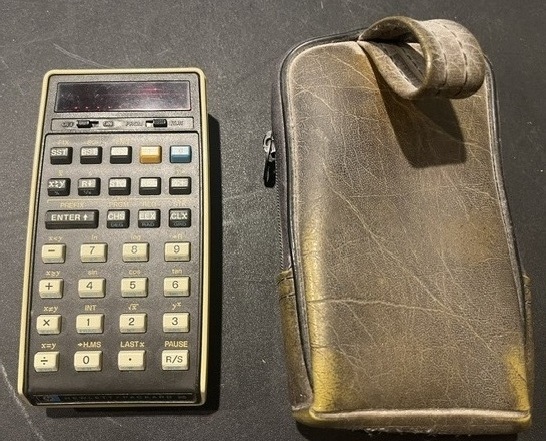
The Hewlett-Packard HP-25, released in 1975, was a groundbreaking programmable scientific calculator that brought affordable programmability to students, engineers, and professionals. Marketed as the "programmable calculator for the price of a non-programmable," it was one of the first pocket-sized machines with true keystroke programming, making complex calculations repeatable without re-entry. It was a milestone in handheld computing, bridging basic calculators and early microcomputers.
Hewlett-Packard (HP), based in Palo Alto, California, pioneered electronic calculators with the HP-35 (1972), the first scientific pocket calculator. The HP-25 was developed by HP's Advanced Products Division, building on the HP-35's RPN (Reverse Polish Notation) system and adding programmability. It targeted engineers and students needing to automate repetitive calculations, competing with Texas Instruments' SR-52 and early programmable models.
Introduced in January 1975 at $195 (later reduced to ~$150), the HP-25 was an instant hit, selling tens of thousands. It was produced through the early 1980s, with a red LED version (HP-25C) adding continuous memory. It was phased out as LCD models and more advanced programmables (e.g., HP-41) emerged. Its compact size and programmability made it a favorite for fieldwork and education.
The HP-25 used custom HP LSI chips. Key features included:
Its 49-step program memory was generous for the time, allowing complex routines like iterative calculations or statistical analysis.
Programming was keystroke-based: users entered operations step-by-step, stored the program, and ran it with one keypress. It supported conditional branching, subroutines, and indirect addressing. No high-level language—pure keystroke programming. Applications included engineering formulas, financial calculations, and statistics. The HP-25C's continuous memory preserved programs across power cycles, a major innovation. HP published program libraries for science, surveying, and business.
The HP-25 democratized programmability in a pocket-sized package, inspiring engineers and students to automate calculations. It was more affordable than the HP-65 (1974) and more capable than basic calculators. As a collectible, surviving units are valued for their role in the calculator-to-computer transition. Restorers often replace LEDs and batteries, using them to demonstrate early programmable logic. The HP-25 remains a symbol of the 1970s calculator boom and handheld computing's rise.