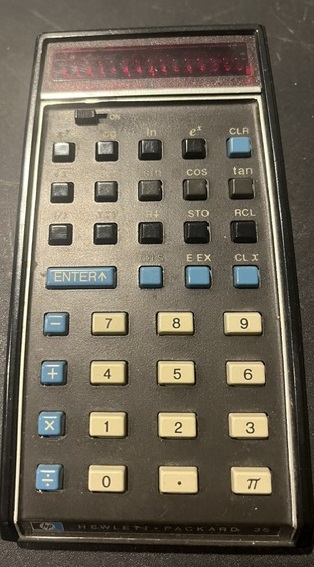
The Hewlett-Packard HP-35, released in February 1972, was the world's first scientific pocket calculator. Marketed as "The Electronic Slide Rule," it made complex scientific calculations portable and affordable, marking a pivotal moment in handheld computing. It was a revolutionary device that brought advanced math to engineers, scientists, students, and professionals, effectively ending the era of mechanical slide rules.
Hewlett-Packard (HP), based in Palo Alto, California, was already a leader in test equipment and calculators. The HP-35 was developed by HP's Advanced Products Division under Bill Hewlett's direction. The goal was to create a pocket-sized calculator with full scientific functions, replacing slide rules and large desktop calculators. It was named "35" for its 35 keys and launched at $395 - expensive but a fraction of previous scientific tools.
Development began in 1970, with the HP-35 launched in 1972 after rigorous testing. It sold over 300,000 units in its first three years, far exceeding expectations. Production ran until 1975, with a total of ~500,000 units made. It was phased out as cheaper LCD models emerged, but its impact was immediate - HP sold out the first year's production in weeks. The HP-35 was a cultural phenomenon, often carried by engineers as a status symbol.
The HP-35 used custom HP MOS-LSI chips. Key features included:
It used Reverse Polish Notation (RPN)—stack-based entry that eliminated parentheses and boosted efficiency for complex calculations.
No programmability—the HP-35 performed instant calculations with RPN. Users entered numbers and operations on a 4-level stack (e.g., 2 [ENTER] 3 [+] for 5). It supported scientific notation, degree/radian modes, and memory recall. No memory registers beyond the stack—later models added this. The HP-35 was purely a calculator, but its accuracy and portability made it indispensable for engineering and science.
The HP-35 revolutionized handheld computing, making slide rules obsolete overnight. It was the first pocket calculator with transcendental functions (trig, logs) and RPN, inspiring generations of HP calculators (HP-25, HP-41, etc.). It was inducted into the Smithsonian and recognized by IEEE as a milestone. As a collectible, surviving units are prized, often restored with LED replacements and batteries. The HP-35 symbolizes the 1970s calculator boom and the dawn of personal computing power in your pocket.