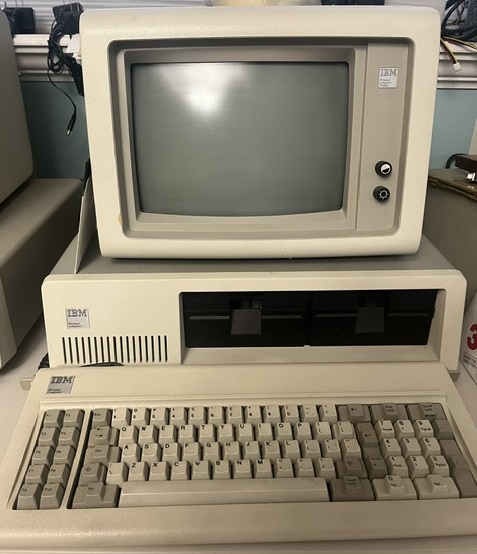
The IBM Personal Computer Model 5150, commonly known as the IBM PC, was announced on August 12, 1981. It marked IBM's entry into the personal computer market and quickly became the de facto standard for business and home computing, establishing the foundation for the modern PC industry and the vast ecosystem of IBM-compatible computers.
The IBM PC was developed by a small independent team at IBM's Entry Systems Division in Boca Raton, Florida, led by Philip Don Estridge (often called the "father of the IBM PC") and chief engineer William C. Lowe. Unlike IBM's traditional closed systems, the team chose an open architecture using off-the-shelf components to bring the product to market quickly and affordably.
Development began in 1980 under "Project Chess," a skunkworks effort to counter the rise of Apple, Commodore, and Tandy computers. In just over a year, the team assembled the machine using non-proprietary parts: an Intel 8088 CPU, Microsoft BASIC and PC-DOS (adapted from 86-DOS), and third-party peripherals. Priced starting at $1,565 for a base configuration (16 KB RAM, no disk drives), it was sold through retailers like ComputerLand and Sears. Initial sales far exceeded expectations, legitimizing personal computers for business use.
The IBM PC 5150 was powered by the Intel 8088 16-bit (externally 8-bit) microprocessor. Key features included:
No hard drive was supported initially; that came with the 1983 PC/XT.
The system shipped with PC-DOS 1.0 (Microsoft's MS-DOS), IBM BASIC, and options for CP/M-86 or UCSD p-System. The open architecture—fully documented bus, BIOS listing, and schematics—encouraged third-party hardware and software, fostering a massive ecosystem.
The IBM PC's success transformed computing, shifting dominance from proprietary systems to open standards. It spawned the IBM-compatible clone industry (starting with Compaq), made Microsoft dominant via MS-DOS, and established the x86 architecture that powers most PCs today. Production of the 5150 ended in 1987, but its influence endures—virtually all modern personal computers trace their lineage to this machine, which brought serious computing to offices, homes, and schools worldwide.