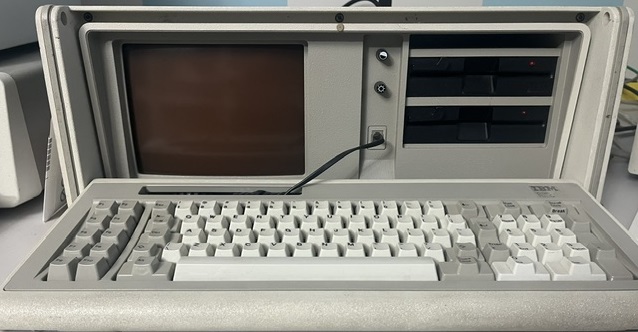
The IBM Portable Personal Computer (model 5155), released in February 1984, was IBM's first "portable" computer—a heavy, luggable design that brought the power of the IBM PC/XT to users needing mobility. Often called a response to the successful Compaq Portable, it allowed business professionals to transport a fully compatible IBM system, though its 30-pound weight earned it the nickname "luggable" rather than truly portable.
The 5155 was developed by IBM's Entry Systems Division in Boca Raton, Florida, the same team responsible for the original IBM PC 5150 and XT 5160. While no single individual is credited as the primary designer (unlike Don Estridge for the 5150), the project built directly on the existing PC/XT architecture to quickly deliver a transportable version amid competition from Compaq.
Introduced after the Compaq Portable's 1983 success demonstrated demand for movable PCs, the 5155 essentially transplanted an IBM PC/XT motherboard into a rugged, suitcase-style case with a built-in monitor and floppy drives. Announced in February 1984, it started at around $4,225 (depending on configuration). No battery was included—it required AC power. Production ended in 1986 as lighter laptops emerged.
The 5155 used the same core as the IBM PC/XT. Key features included:
The case featured a carrying handle, making it transportable but bulky.
Fully compatible with IBM PC/XT software, it shipped with PC-DOS 2.x supporting directories and larger drives. The open ISA bus allowed extensive third-party expansions, though the built-in CGA card produced lower-resolution text on the internal monitor compared to competitors.
While not as commercially dominant as the Compaq Portable (due to higher price, heavier weight, and lower-resolution built-in display), the 5155 reinforced IBM's brand in business computing and proved demand for transportable PCs. It bridged the gap between desktops and true laptops, influencing later designs. Today, surviving units are prized by collectors for their rugged construction and historical role in the early portable computing era.