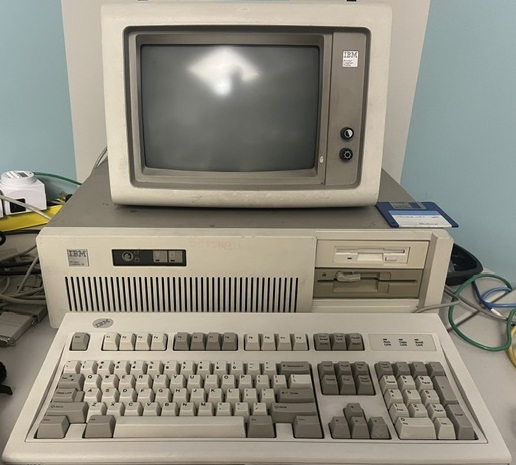
The IBM Personal Computer/AT (model 5170), released on August 14, 1984, represented a major leap forward in the IBM PC line. Known as the PC/AT ("Advanced Technology"), it introduced the faster Intel 80286 processor, a true 16-bit architecture, improved hard drives, and enhanced expandability, setting the standard for high-performance business computing throughout the late 1980s.
The 5170 was developed by IBM's Entry Systems Division in Boca Raton, Florida, under the continued leadership of Philip Don Estridge until his tragic death in a plane crash in 1985. The design team aimed to deliver significantly more power while maintaining backward compatibility with the existing IBM PC/XT software and hardware ecosystem.
Announced in 1984, the PC/AT addressed growing demands for speed and storage in professional applications. Initial configurations included a 6 MHz 80286, 512 KB RAM, a 20 MB hard drive, and a high-density 1.2 MB 5.25-inch floppy drive. Priced starting around $5,795, it targeted corporate and power users. Later revisions (e.g., 339 and others) offered 8 MHz versions and larger drives. Production continued until 1987, when it was succeeded by PS/2 models.
The PC/AT introduced the Intel 80286 and a new 16-bit ISA bus. Key features included:
The battery-backed real-time clock (later standard) and improved BIOS setup became industry norms.
Shipped with PC-DOS 3.0, which supported larger hard drives (over 32 MB via partitioning) and 1.2 MB floppies. The 80286's protected mode enabled future multitasking OSes like OS/2, though most software initially ran in real mode for XT compatibility. The 16-bit bus and faster CPU dramatically improved performance for spreadsheets, databases, and CAD.
The PC/AT defined the "AT-class" machine and established the 16-bit ISA bus (later called Industry Standard Architecture) as the dominant expansion standard for years. Its architecture influenced countless clones, extending the IBM-compatible ecosystem. The 80286's protected mode laid groundwork for modern operating systems. Though overshadowed by the PS/2 line, the AT remains a milestone—representing the transition from early personal computers to powerful, professional workstations that dominated offices worldwide.