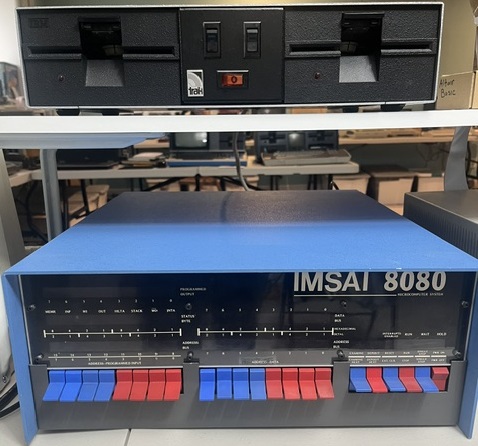
The IMSAI 8080, released in December 1975, is widely recognized as the first "clone" microcomputer and a direct competitor and improved copy of the MITS Altair 8800. It played a key role in expanding the early personal computing market by offering greater reliability, easier assembly, and full compatibility with the emerging S-100 bus ecosystem.
The IMSAI 8080 was developed by IMS Associates, Inc. (later IMSAI Manufacturing Corporation), founded in 1973 by William "Bill" Millard in San Leandro, California. Millard, a former IBM employee and data processing manager, started the company as a consulting firm before pivoting to hardware. Facing long delivery times for Altair 8800 units needed for a project, Millard and chief engineer Joe Killian decided to build their own compatible system around the Intel 8080 microprocessor.
Development accelerated in 1975, with the design emphasizing improvements over the Altair: a single 22-slot motherboard (versus Altair's segmented board requiring wiring), a more robust power supply, and simpler front-panel connections. Advertised in Popular Electronics starting October 1975, the first kits shipped on December 16, 1975. Priced at $439 as a kit and $621 assembled (later around $599 kit/$931 assembled), it quickly gained popularity. Over 17,000 to 20,000 units were produced until 1978.
The IMSAI 8080 was powered by the Intel 8080A (later compatible with 8085) 8-bit microprocessor. Key features included:
Like the Altair, basic operation used front-panel switches and LEDs; peripherals like terminals and floppy drives were added via expansion cards.
The IMSAI ran CP/M (licensed in 1977, modified as IMDOS), enabling disk-based operation and higher-level programming. Its full S-100 compatibility fostered a rich third-party ecosystem, including floppy controllers and BASIC interpreters. Improvements like the larger power supply and single-board motherboard made it more user-friendly for expansion than the original Altair.
The IMSAI 8080 solidified the S-100 bus as an industry standard and demonstrated the viability of cloning successful designs, spurring competition and innovation. It outsold the Altair in some periods and became iconic—famously featured as the hacker's computer in the 1983 film WarGames. Though IMSAI shifted focus to retailing (founding ComputerLand) and ceased hardware production by the late 1970s, the machine remains a symbol of the microcomputer revolution. Surviving units and modern replicas are prized by collectors and retro-computing enthusiasts.