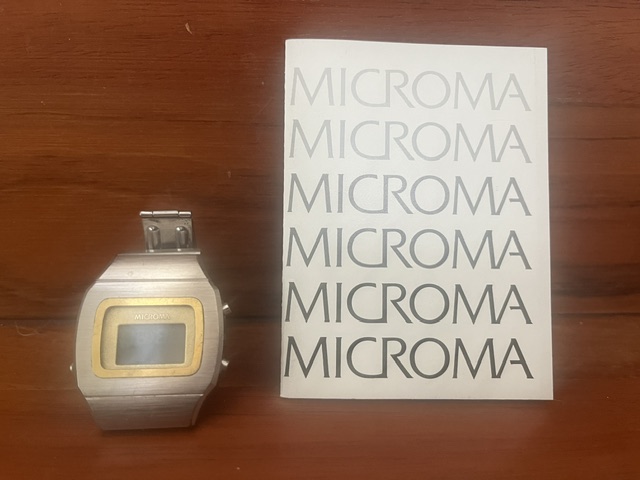
In the mid-1970s, while working at Standard Supply Electronics Co. in Salt Lake City, I bought a Microma LCD digital watch. It was stainless steel and one of the earliest examples of a practical LCD digital watch. At the time, it felt like owning a piece of the future. Ironically, when I came home with the Microma, my Father saw the watch was nicer than his. At the time he had a lower-cost plastic LED watch. Out of respect for my Father, I swapped watches with him. After my Father passed away, I got my watch back. This write-up covers the history of Microma, the watch itself, its significance as an early LCD timepiece, cost, and why it was such a landmark product in consumer electronics.
Microma was originally a small Silicon Valley startup focused on digital watches. In July 1972, Intel acquired Microma for $15 million to enter the consumer electronics market and showcase its new CMOS technology. Intel turned Microma into a showcase for its chips, producing some of the first commercially available LCD digital watches. The company introduced the first continuous-display LCD watch in 1972 (earlier LED watches only lit up when a button was pressed). By 1974-1975, Microma watches were sold through major retailers like Sears and department stores. Intel eventually sold the division in 1978 after struggling with high return rates and competition, but the brand helped popularize digital watches worldwide.
My watch was a stainless steel Microma model from the mid-1970s (likely 1974-1976). It featured a sleek, modern design with a black LCD display that showed hours, minutes, and seconds continuously - a major advancement over earlier LED watches that only displayed time when a button was pressed. The watch used Intel's early CMOS chips and a liquid crystal display that was visible in daylight without backlighting. It was powered by a small silver-oxide battery that lasted months. The case was durable stainless steel with a mineral crystal, giving it a premium feel for the era.
Early Microma watches retailed for $200-$300 in 1974-1975 (roughly $1,200-$1,800 in 2026 dollars), making them luxury items. By 1975, simpler models dropped to around $69.95. They were sold at electronics stores, department stores, and specialty shops like Standard Supply Electronics in Salt Lake City. At the time, owning one was a status symbol - digital watches were still new and exciting technology.
The Microma was one of the first practical LCD digital watches available to the public. It helped transition the world from mechanical and LED watches to the always-on LCD displays we take for granted today. Intel's involvement showed how semiconductor companies were pushing into consumer products, paving the way for the digital revolution. For me, it was a tangible symbol of the future arriving in my pocket - and a reminder of how rapidly technology was changing in the 1970s.
Although Intel exited the watch business in 1978, Microma watches remain collectible today. They represent an important early chapter in digital timekeeping and the consumer electronics boom. In the MicroBasement, my stainless steel Microma stands as a bridge between the analog world of the past and the digital world we live in now - a small but powerful reminder of when the future first appeared on our wrists.