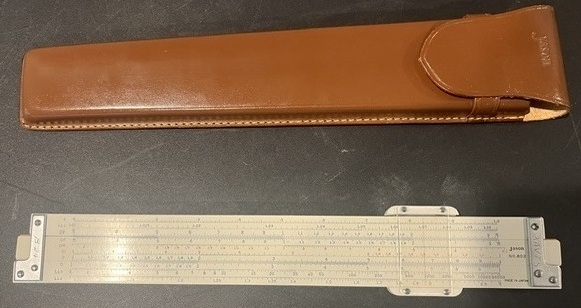
The Jason N.o. 802 is a 10-inch slide rule produced by the Japanese company Jason (also known as JASON or Nihon Keiki) in the 1960s - 1970s. A popular, affordable model for students and engineers, it featured a classic Mannheim design with a cursor and basic scales. In the MicroBasement, the N.o. 802 represents the international proliferation of slide rules during the post-war era, when Japanese manufacturers offered high-quality alternatives to Western brands at lower prices. This write-up covers the history of Jason slide rules, the N.o. 802 model, its features, cost, functionality, and legacy.
Jason was a Japanese brand under Nihon Keiki Seisakusho (Japan Precision Instruments), active in the 1950s - 1980s. After WWII, Japan rebuilt its precision manufacturing industry, producing slide rules as affordable alternatives to expensive American (K&E, Pickett) and German (Aristo, Nestler) models. Jason rules were exported worldwide, especially to the U.S., Europe, and Asia, competing on price and quality. By the 1960s, Jason was one of the most common brands in schools and hobbyist circles. Production declined in the 1970s as electronic calculators emerged, and the company faded by the 1980s.
The Jason N.o. 802 was a standard 10-inch (25 cm) linear slide rule, introduced in the 1960s. It was a Mannheim-type rule with a single slide and cursor, made from laminated plastic with engraved scales. It was sold with a leatherette case and often included a manual. The model was popular among high school/college students and amateur engineers for its simplicity and low cost. Variants included the N.o. 802-S (with additional scales) and similar models like N.o. 801 or N.o. 803.
The N.o. 802 retailed for $3 - $7 in the 1960s - 1970s (about $25 - $50 in 2026 dollars), making it one of the cheapest quality slide rules available. It undercut American brands (Pickett/K&E at $15 - $30) and was widely sold through mail-order catalogs, school suppliers, and electronics stores. Today, vintage examples sell for $10 - $40 on eBay, depending on condition.
The N.o. 802 was a basic Mannheim rule with:
It was ideal for schoolwork, basic engineering, and amateur radio calculations, though it lacked advanced log-log or specialized scales.
The Jason N.o. 802 and similar Japanese rules made slide rules accessible worldwide, helping spread engineering education in developing countries. Though displaced by calculators, they remain collectible. In the MicroBasement, the N.o. 802 highlights the global reach of analog computing tools, showing how affordable precision instruments empowered a generation before digital took over.