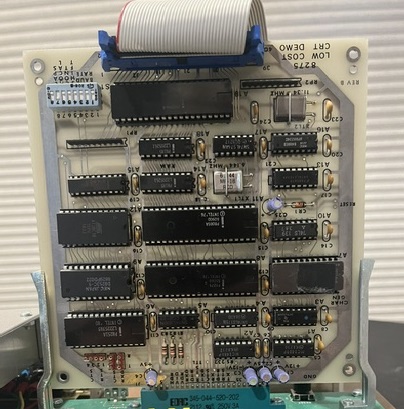
The John Bell Engineering 8275 CRT Controller is a S-100 bus-compatible video board designed for hobbyists in the early 1980s. It provided a low-cost way to add CRT display capabilities to microcomputers like the Altair or IMSAI. I bought the PCB in the early 80s to build this controller. In the MicroBasement, it represents the DIY spirit of the microcomputer era - a project that let enthusiasts create their own video terminals. This write-up covers the history of John Bell Engineering, other products and services, the CRT controller's architecture and chipset, and its significance for hobbyists.
John Bell Engineering was a small company founded in the early 1980s in the U.S. (likely California or New Hampshire based on mailing addresses in ads). It specialized in low-cost microprocessor boards and peripherals for hobbyists entering the microcomputer era. The firm operated through the 1980s - early 1990s, producing S-100 bus products for 6502 and Z80 systems. John Bell aimed to make computing accessible by offering affordable kits and PCBs that users could assemble themselves. The company advertised in magazines like Byte and Kilobaud, emphasizing simplicity and value for beginners. It dissolved in the early 1990s as the PC era took over.
John Bell Engineering offered a range of low-cost S-100 boards and SBCs:
They provided kits, PCBs, and assembled boards, along with manuals and software. Services included technical support via mail and phone for hobbyists building systems. Their focus was on enabling affordable entry into microcomputing for enthusiasts.
The 8275 CRT Controller is an S-100 bus board with an 8085A microprocessor at 3 MHz, supported by two 8185 1K x 8 RAMs and a 2716 PROM for control software. Key chipset includes:
Architecture is divided into processor/support, serial/parallel I/O, and CRT control. It uses memory-mapped I/O and supports baud rate selection via switches. Output is not NTSC standard — it's for custom CRT monitors like Ball Brothers TV-12.
John Bell created low-cost projects like this CRT controller to help hobbyists enter the microcomputer era without breaking the bank. For $100 - $200 (kit/PCB), users could build a video terminal for S-100 systems, learning assembly, soldering, and hardware integration. It was perfect for Altair/IMSAI owners wanting affordable displays. Today, surviving boards are rare collectibles for vintage restorations.
The 8275 CRT Controller exemplifies the hobbyist-driven innovation of the 1980s microcomputer scene. It made advanced features accessible, fostering the DIY spirit that led to the PC revolution. In the MicroBasement, it's a hands-on link to the era when building your own CRT controller was the gateway to computing power.