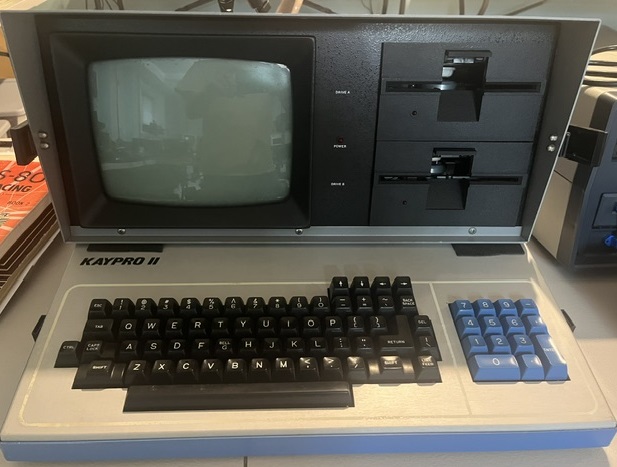
The Kaypro II, released in 1982, was one of the most successful "luggable" portable CP/M computers of the early 1980s. Rugged, affordable, and bundled with a generous software package, it became a favorite among business users, writers, and professionals needing a reliable machine on the go. Often called the "poor man's Osborne," it outsold its rival and helped popularize portable computing.
Designed by Non-Linear Systems (founded by Andrew Kay, inventor of the digital voltmeter) under the new Kaypro Corporation brand. David Kay led the project, aiming for a more durable, professional alternative to the Osborne 1. The all-metal case and thoughtful bundling reflected a focus on practicality over flash.
Announced in 1982 at $1,795, the Kaypro II shipped in early 1983. It quickly gained traction with strong reviews for build quality and software bundle. Over 10,000 units sold monthly at peak. Variants like Kaypro IV and 10 followed; the line continued until 1985 when IBM PC compatibles dominated. Kaypro declared bankruptcy in 1992, but the II remains iconic.
The Kaypro II was a Z80-based CP/M machine. Key features included:
Later models (Kaypro IV) added double-density support for 390 KB drives.
Ran CP/M 2.2 with a rich bundle: WordStar, SuperCalc, Microsoft BASIC, dBase II, and utilities—worth thousands separately. The large 9-inch screen improved readability over Osborne's 5-inch. Rugged metal case protected components; users praised reliability in travel. Add-ons included hard drives and graphics boards.
The Kaypro II proved portables could be professional tools, outselling Osborne and influencing Compaq/Kaypro competitors. Its CP/M ecosystem supported serious business apps before DOS dominance. Beloved for durability ("built like a tank"), it introduced many to computing. Today, Kaypro IIs are collectible, with retro enthusiasts restoring them, adding CF/SD interfaces, and running CP/M software via emulators. It symbolizes the brief but vibrant CP/M portable era.