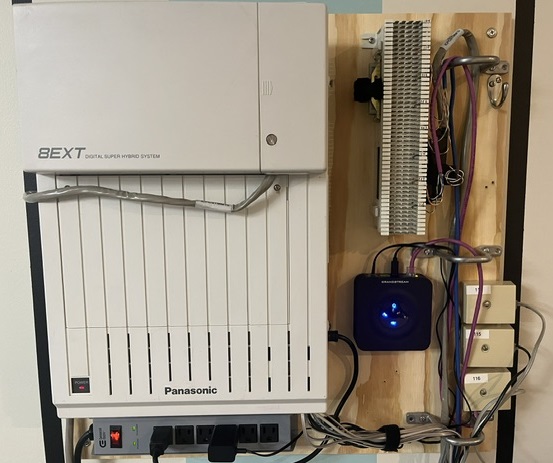
The Panasonic KX-TD816 is a digital hybrid PBX (Private Branch Exchange) system from the 1990s, known for its reliability and flexibility in small to medium businesses. Paired with the KX-TD170 8EXT 8-port extension card, it expands analog capabilities. This page covers its specs, features (including pulse dial and touch-tone phones), a general write-up on phone systems, PBX history vs. large exchanges, and why it's in the MicroBasement collection.
The KX-TD816 is a compact wall-mount or rack-mount PBX with modular expansion.
The KX-TD816 offers robust features for small offices:
It handles both pulse dial (rotary) and TT phones seamlessly, making it ideal for mixed setups.
Phone systems range from small home setups to large enterprise networks. Small systems (e.g., key telephone systems for 2-8 lines) are typically used for homes or small businesses, offering basic features like hold/transfer. Large systems (PBX or IP-PBX) serve medium/large businesses with hundreds of extensions, advanced routing, voicemail, and integration. They reduce costs by sharing external lines internally. Modern systems are VoIP-based, cloud-hosted for scalability.
PBX (Private Branch Exchange) history dates to the late 19th century. Early PBX (1890s) were manual switchboards for businesses to handle internal/external calls privately, differing from large public exchanges (central offices) that managed city-wide connections. Automatic PBX (PABX) emerged in the 1960s with electromechanical switches (Strowger/crossbar), reducing operators. Digital PBX (1970s - 1980s) added features like voicemail. IP-PBX (1990s+) shifted to VoIP. PBX are private, on-premises switches for organizations (small/large business use); large exchanges are public carrier switches handling massive traffic across regions.
The reason I have this in the MicroBasement collection is that analog phone lines are not readily available. The Panasonic KX-TD816 provides an experimental environment where I can demonstrate dial and touch tone telephones, dial-in BBS's (Bulletin boards of the 1980s), as well as a dial-up Internet service from the early 1990s. The system has the capability of handling 16 extensions with many features.