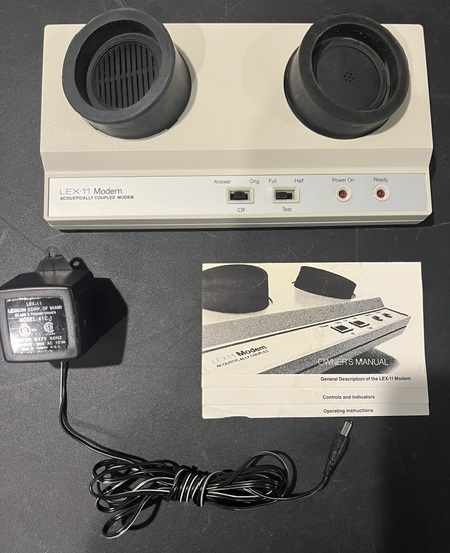
The Lex 11 Acoustical Coupler modem was a 300 baud device from the early 1970s, produced by Lexicon (later APC). It allowed computers to connect to phone lines without direct electrical attachment, using acoustic coupling via a standard telephone handset. This was necessary due to legal restrictions on non-Bell equipment. In the MicroBasement, it represents early data communication ingenuity. This write-up covers its history, speeds, technical aspects, widespread use, equivalent manufacturers, and downsides.
The Lex 11 emerged in the late 1960s/early 1970s, during a time when Bell System's monopoly prohibited direct connections to phone lines. The 1968 Carterfone decision began changing this, but acoustic couplers remained common until modular jacks in 1976. Lexicon (APC) targeted hobbyists and small businesses with affordable modems. The Lex 11 was priced at $159, making it accessible for early computer users like ARPANET nodes or teletype systems.
The Lex 11 operated at 300 baud (bits per second), typical for acoustic couplers. This enabled full-duplex communication at 300 bps, suitable for text terminals but slow for data transfer (about 30 characters/second). Higher speeds were possible with direct-connect modems post-1976, but acoustic limits (audio frequency constraints) kept it at 300 baud.
The Lex 11 used rubber cups to hold a telephone handset, converting data to audio tones (Bell 103 standard: 1070/1270 Hz for mark/space from originator, 2025/2225 Hz from answerer). It included a speaker/microphone for coupling, RS-232 interface for computers, and power from an AC adapter. Compact and portable, it worked with any phone, but required manual dialing and careful placement to avoid distortion.
Acoustic couplers like the Lex 11 were widely used from the 1960s to mid-1980s in computing, telecommunications, and early internet (ARPANET). They enabled remote terminals, time-sharing, and BBS access before direct modems. By the 1980s, millions were in use globally, but declined after FCC approvals for modular connections.
Other companies produced similar acoustic couplers:
Acoustic couplers were noise-prone, with ambient sounds (e.g., talking, traffic) causing errors or disconnections. Poor handset seals led to distortion, and speeds were limited to 300 baud due to audio bandwidth. They were bulky, required manual setup, and incompatible with some phones. Reliability suffered in humid or dusty environments, and they were phased out as direct-connect modems offered higher speeds (1200 - 2400 baud) and better performance.
The Lex 11 highlights early modem innovation under legal constraints. Acoustic couplers enabled the data revolution, paving the way for modern broadband. In the MicroBasement, it demonstrates how necessity drove creative solutions in telecommunications history.