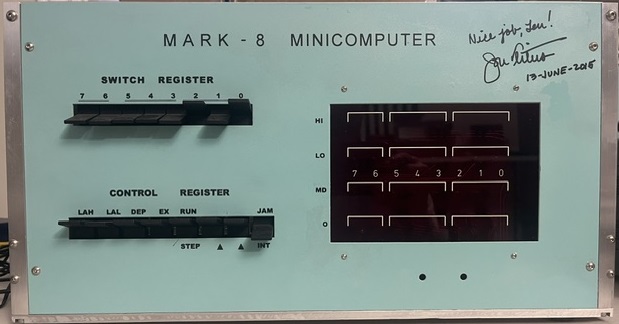
The Mark-8 Microcomputer holds a significant place in the history of personal computing as one of the earliest do-it-yourself microcomputer kits available to hobbyists. Introduced as a construction project in the July 1974 issue of Radio-Electronics magazine, it predated more famous systems such as the Altair 8800 and IMSAI 8080, but still the Mark-8 helped spark the microcomputer revolution of the 1970s.
The Mark-8 was designed by Jonathan A. Titus, then a graduate student in chemistry at Virginia Polytechnic Institute and State University (now known as Virginia Tech). Titus, who had a background in electronics and engineering, became fascinated with the potential of microprocessors after learning about the Intel 8008 CPU. As a student, he saw the opportunity to create an affordable computing device that individuals could build and experiment with at home. He aimed to make computers accessible outside large institutions and corporations.
In early 1974, Titus developed the Mark-8 using the 8-bit Intel 8008 microprocessor, released by Intel in 1972. The design was simple yet innovative for its time, focusing on a project enthusiasts could assemble themselves. Rather than selling a complete computer or kit, Titus contracted with a printed-circuit board (PCB) manufacturer to sell sets of six board for $50. More than 500 board sets were reportedly sold, although more people likely built versions from the magazine plans. Experimenters would buy components from parts distributors.
The project gained widespread attention when it appeared on the cover of the July 1974 issue of Radio-Electronics magazine. The article, "Build the Mark-8: Your Own Minicomputer," provided "get started" information. To help Mark-8 builders, Radio-Electronics sold a $5 booklet that included schematics, PCB circuit layouts, assembly instructions, parts lists, and several experiments.
The original Mark-8 specifications included:
Titus mounted the six circuit boards in a chassis about the size of a large breadbox. LEDs shined through a section of transparent red plastic. The Mark-8 had no built-in long-term data storage (ROM or PROM), keyboard, or display. People entered data manually via the switches, and results appeared on the front panel's LEDs. Power requirements were modest and available from a standard power supply. The total cost to build a Mark-8 Minicomputer, including parts, was around $200-$250 in 1974 dollars.
Building the Mark-8 was not for the faint-hearted. It required soldering skills, debugging, and patience. It had no operating system or high-level programming language initially. Users programmed in machine code or assembly language. Despite these limitations, the Mark-8 demonstrated the feasibility of personal microcomputers. It included innovative features such as memory expansion ports and the ability to interface with Teletype-style machines or other devices, paving the way for more advanced systems.
While not as commercially successful as the later Altair 8800, the Mark-8 is recognized as one of the first microcomputer kits and a precursor to the home computer era. It inspired user groups, such as the Mark-8 Users Group, where enthusiasts shared programs and modifications. Titus went on to co-found Tychon, Inc. with his brother Christopher and two colleagues at Virginia Tech. The company also contributed to other early computing and educational projects.
Today, surviving Mark-8 units are rare and valuable collector's items, often fetching thousands of dollars at auctions. The Smithsonian Institution holds the original computer assembled by Titus, but as of now it is not on display, but available to researchers. The Mark-8 symbolizes the do-it-yourself (DIY) spirit that fueled the personal computer revolution, and proved that computing power could be available to almost anyone.
The Mark 8 in the Microbasement was completed in 2015. The project began life when printed circuit boards were purchased off of eBay around 2001. These were boards made by an individual hobbyist and not those made originally by Jon. Along with the boards, the seller included a partial kit that contained the ICs, switches, and other miscellaneous parts.
The time span of 14 years to complete the project was mainly due to not wanting to rush it. It took a few years to acquire more parts, but also to thoughtfully decide how to do justice to the build. The original Mark 8 Jon built was physically wired together, making it difficult to maintain and expand. When Jon designed the boards he brilliantly laid the connection bus out on a 0.156-inch center. This layout was actually intended to be used with Molex connectors. When I built my Mark 8 I opted to design a Molex plug-board backplane and populate the cards with the female connectors. This made my Mark 8 much easier to troubleshoot and also expand.
As Jon intended the Mark 8 to be a “base” for expansion and experimentation, I took up the challenge. My Mark 8 contains both a custom memory board (static RAM and EPROM) and also a video card. The memory card uses 16k AM2167s that would have been available in the late 1970s. The EPROM comes in the form of two 2716s. Other than that the board is all TTL. The ROM locations and size are highly configurable. The video card is also built using all TTL. It interfaces to the Mark 8 bus using four output port addresses. It displays 16 lines of 32 characters. The character generator ROM data was dumped from an MCM6571 and burned into a 2716 EPROM so no hard-to-obtain ICs were needed. The character set supports both upper and lower case letters. Cleverly I used the MM5321 TV camera sync generator to produce the vertical and horizontal sync signals for the timing chain of the video card.
Jon and I have had many philosophical discussions about originality. Unlike so many of the microcomputers created during the same era, Jon produced a packet of information. The packet contains schematics, circuit board layouts, and other really useful information so a hobbyist could build their own Mark 8. Anyone with the information could produce their own circuit boards. In those days there were many of us who wanted a computer with little idea of what we would use one for. But in the end I think the Mark 8 changed the mentality that computers were out of the reach of an average hobbyist. In many “basements” across America, and around the world, the Mark 8 became the spark that created an industry and changed the world.