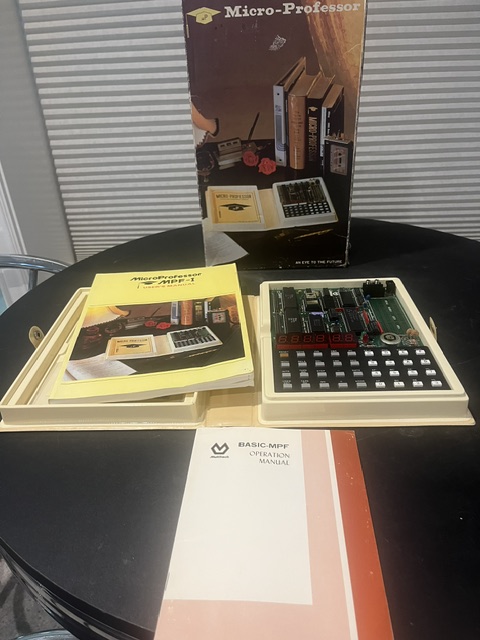
The Multitech Micro-Professor MPF-I, introduced in 1981, was a highly popular educational microprocessor trainer kit, especially in Europe, Asia, and educational markets worldwide. Designed as an affordable learning platform for the Zilog Z80 CPU, it combined a simple single-board computer with a built-in Tiny BASIC interpreter, making it ideal for teaching assembly language, interfacing, and basic programming.
The MPF-I was developed by Multitech Industrial Corporation (later renamed Acer Inc.) in Taiwan. Founded by Stan Shih in 1976, Multitech aimed to bring microprocessor education to schools and hobbyists at low cost. The design drew inspiration from earlier trainers like the KIM-1 and Heathkit ET-3400, but added integrated BASIC and extensive documentation for classroom use.
Launched in 1981 as the MPF-I (later MPF-IB and MPF-IP with minor updates), it was sold as a kit or assembled for around $150-$200. Distributed globally (often rebadged as Acetronic or other brands), it sold hundreds of thousands of units, particularly in the UK, Germany, and Asia. Multitech released detailed manuals, textbooks, and expansion boards (e.g., EPROM programmer, sound, VDU). Production continued into the late 1980s.
The MPF-I was built around the Zilog Z80A microprocessor. Key features included:
Compact case with integrated power supply; no standard video output (add-on required).
The ROM included a monitor for hex entry/examination and Tiny BASIC for immediate programming. Users toggled machine code or typed BASIC programs (e.g., games, math). Extensive manuals taught Z80 assembly, interfacing (LEDs, switches, DACs), and projects. With expansions: graphics, sound, more RAM. Hobbyists wrote monitors, assemblers, and games, sharing via user groups.
The MPF-I made Z80 education affordable and widespread, especially in schools lacking full computers. Its all-in-one design, quality documentation, and expandability set it apart from bare trainers. Many engineers credit it as their first microprocessor experience. While overshadowed by home computers like the ZX Spectrum, its educational focus endured. Surviving MPF-I units are collectible, with active retro communities building modern interfaces (e.g., SD card loaders, VGA output) and emulators preserving its role in teaching computing fundamentals.