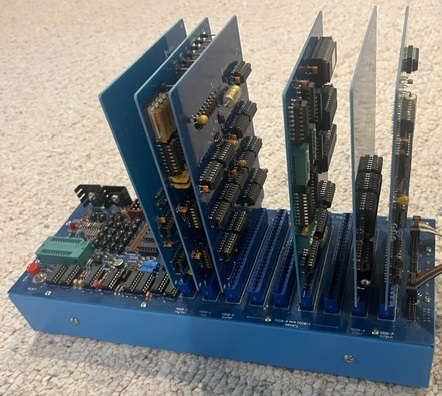
The MIL Mod 8 (also known as the MOD-8) was a Canadian-designed modular microcomputer introduced in late 1973 or early 1974. Based on the Intel 8008 microprocessor (or its second-source equivalent), it was one of the earliest 8-bit microcomputer systems available to hobbyists and served as a low-cost prototyping platform during the dawn of the personal computing era.
The Mod 8 was developed by Microsystems International Limited (MIL), a semiconductor manufacturer based in Ottawa, Ontario, Canada. Founded in 1969 as a subsidiary of Northern Electric (later Nortel), MIL produced a range of integrated circuits, including second-source versions of Intel microprocessors under license. The company designed the Mod 8 as a modular prototyping system around their MF8008 CPU chip (a clone of the Intel 8008), similar to Intel's own MCS-8 development kit.
Originally intended for internal development and professional use, the Mod 8 quickly gained popularity among North American computer hobbyists after MIL distributed free copies of the MF8008 Applications Manual, which included detailed schematics, software listings, and a monitor program. Bare boards were manufactured and sold by companies like Space Circuits in Waterloo, Ontario, while fully assembled systems were offered by distributors such as Moducomp Inc., Great Northern Computers, and Mini Micro Mart. Despite MIL's closure in early 1975 due to financial difficulties, board production and sales continued for several years, sustaining the system's popularity into the late 1970s.
A later upgrade path to the Mod 80 allowed users to swap in an MF8080 CPU board for compatibility with the more powerful Intel 8080.
The Mod 8 was built around the MF8008 (or Intel 8008) 8-bit microprocessor. Key features included:
The system used separate plug-in cards for major functions, making it highly expandable and easy to prototype new designs.
The Mod 8 included Monitor-8, a basic machine-language monitor in ROM for loading, examining, and executing programs via a teletype. Programs were typically entered in octal or hex via the terminal. The Applications Manual provided extensive software examples and was widely read among early 8008 enthusiasts.
Though initially overshadowed by U.S. designs like the Mark-8 and Scelbi-8H, the Mod 8 became a popular entry-level system for hobbyists, including members of the Homebrew Computer Club. Its modular design influenced later kits, and its continued availability after MIL's demise helped sustain the 8008 ecosystem. Surviving Mod 8 systems are rare today and preserved in collections like the York University Computer Museum in Canada. The Mod 8 represents an important chapter in Canadian computing history and the global spread of the microcomputer hobbyist movement.