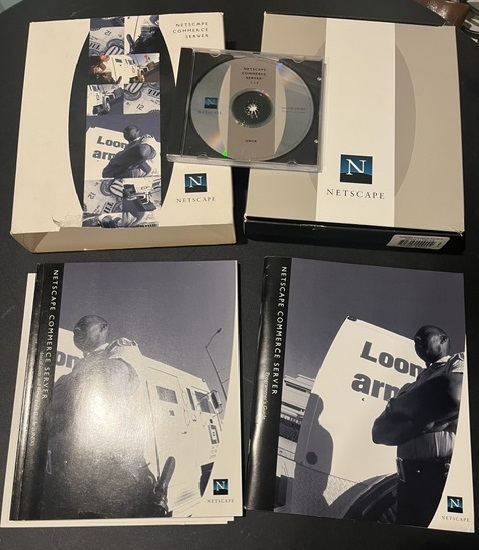
Netscape Commerce Server 1.1 was a groundbreaking web server that introduced Secure Sockets Layer (SSL) encryption, enabling secure online transactions for the first time. Released in early 1995, it marked a pivotal moment in Internet history, transforming the web from a static information platform into a secure space for commerce. In the MicroBasement, Netscape Commerce Server represents the dawn of the e-commerce era - a technology that helped shift billions in retail from brick-and-mortar stores to online. This write-up covers the origins of Netscape, how it improved on NCSA httpd with SSL, the release details, cost, sales, and its revolutionary impact on the Internet.
Netscape was founded in April 1994 as Mosaic Communications Corporation by Marc Andreessen (co-creator of NCSA Mosaic browser) and Jim Clark (Silicon Graphics founder). Initially focused on the Mosaic browser, the company quickly expanded to servers. Renamed Netscape Communications in November 1994 to avoid trademark issues with NCSA, it aimed to commercialize the web. Netscape's early success came from Navigator, but Commerce Server was key to enabling secure business on the Internet.
The NCSA httpd (HTTP Daemon) server, released in 1993, was the first widely used web server but lacked security features like encryption. It transmitted data in plain text, making it vulnerable for sensitive information. Netscape addressed this by developing Secure Sockets Layer (SSL) - a protocol that encrypts data between client and server. SSL 1.0 was internal; SSL 2.0 launched with Commerce Server, providing secure transport for credit cards and personal data. This "quantum leap" turned the web into a safe platform for e-commerce, replacing insecure brick-and-mortar alternatives with online shopping.
Netscape Commerce Server 1.0 was released on December 15, 1994, with Version 1.1 following in early 1995 (around March, alongside Navigator 1.1). It retailed for $5,000 (about $10,000 in 2026 dollars), while the non-SSL Communications Server cost $1,495. Sales figures aren't precise, but Netscape servers quickly gained market share, with over 100,000 units sold by mid-1995. It shook up the market, inspiring competitors like Apache (1995) and Microsoft IIS.
Netscape Commerce Server and SSL created the secure Internet we know today. It enabled e-commerce giants like Amazon and eBay, shifting trillions in retail from physical stores to online. Without SSL, the web might have remained a curiosity rather than a global economy. In the MicroBasement, it stands as a testament to how one innovation - secure data transport - sparked the digital commerce revolution.