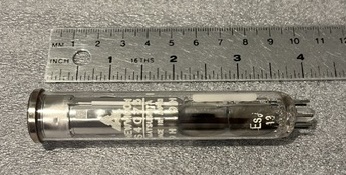
The Newvicon S4075 is a high-performance vidicon-type camera tube developed by Matsushita (Panasonic) in the late 1960s-early 1970s. It offered significantly better sensitivity, lower lag, and improved resolution compared to standard vidicons, making it a favorite in professional and industrial video cameras. In the MicroBasement, the S4075 represents the peak of vidicon technology just before solid-state sensors began to dominate. This write-up covers what the S4075 is, how it worked, the history of Newvicon tubes, comparison to the Image Orthicon, cost, supporting circuitry, time period, and legacy.
The S4075 is a 1-inch Newvicon camera tube designed for low-light and high-quality video applications. It uses a zinc cadmium telluride (ZnCdTe) photoconductive target, which gives it superior sensitivity and spectral response (especially in the near-infrared) compared to standard antimony trisulfide Vidicon targets. It was widely used in broadcast, surveillance, medical imaging, and industrial cameras from the 1970s through the 1980s.
Like the Vidicon, the S4075 operates on the photoconductive principle:
The Newvicon target material provided much lower lag (less ghosting) and higher sensitivity than standard Vidicons, making it suitable for low-light and dynamic scenes. It required a magnetic focus/deflection yoke and high-voltage supplies similar to other vidicons.
Newvicon tubes were invented by Matsushita Electric (Panasonic) in Japan in the late 1960s. The first Newvicon tubes appeared around 1969-1970, with the S4075 becoming a popular model in the early 1970s. The name "Newvicon" combines "new" and "vidicon," reflecting its improved photoconductive target. Matsushita aggressively marketed Newvicons for professional and industrial use, and they were quickly adopted by camera manufacturers worldwide. Newvicons were a major step forward in vidicon technology, bridging the gap between the older Vidicon/Plumbicon and emerging solid-state sensors.
While the Image Orthicon (e.g., RCA 7293A) was the gold standard for broadcast studios in the 1950s-1960s (extremely high sensitivity, excellent low-light performance), the Newvicon S4075 offered advantages in:
Image Orthicons remained superior in ultimate low-light performance and picture quality for live TV until the late 1960s, but Newvicons largely replaced them in industrial, surveillance, and portable cameras by the mid-1970s.
Newvicon S4075 tubes retailed for $300-$600 each in the 1970s (roughly $1,800-$3,600 in 2026 dollars), depending on the camera manufacturer and quantity. They were used in thousands of professional and industrial cameras, including:
They were a staple in Japanese and European camera brands (Sony, Hitachi, Philips) and many U.S. industrial cameras.
The S4075 required similar supporting circuitry to other vidicons:
These were housed in camera control units or built into the camera head. Newvicons were easier to drive than Image Orthicons due to lower voltage requirements and simpler electronics.
The S4075 and other Newvicon tubes were widely used from the early 1970s through the late 1980s. They dominated industrial and some broadcast applications until CCD sensors became affordable in the late 1980s-early 1990s.
The S4075 and Newvicon family marked the final evolution of photoconductive camera tubes before solid-state sensors took over. They offered excellent performance in a smaller, more reliable package than the Image Orthicon. In the MicroBasement, the S4075 is a beautiful example of 1970s tube technology at its peak - sensitive, rugged, and capable of producing high-quality images in challenging conditions.