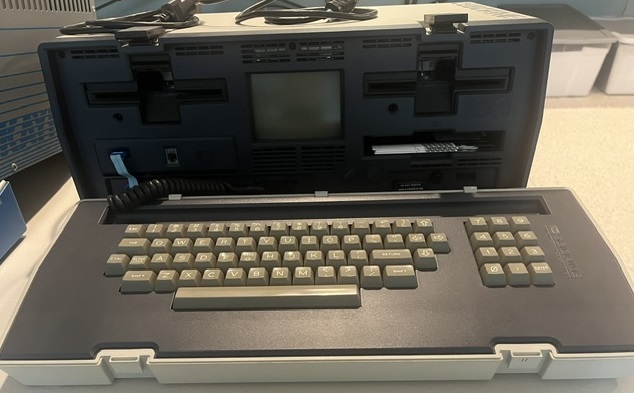
The Osborne 1, released in April 1981, was the first commercially successful portable computer, weighing 24 pounds and designed to fit under an airline seat. It brought business computing on the go with bundled software and built-in storage. The Osborne 1A (1982) was a minor revision with improved reliability and compatibility, helping extend the line's life amid growing competition from IBM and Compaq.
Adam Osborne, a British-American author and publisher (famous for books like "Running Wild: The Next Industrial Revolution"), founded Osborne Computer Corporation in 1980. He envisioned an affordable, portable "luggable" machine with software bundle to disrupt the market. Lee Felsenstein designed the hardware, drawing from his Homebrew Computer Club experience.
Debuted at the 1981 West Coast Computer Faire for $1,795, the Osborne 1 included WordStar, SuperCalc, and BASIC - value exceeding the price. It sold 11,000 units in the first year. The 1A (1982) addressed early issues like screen flicker and double-density floppy support. By 1983, competition and the "Osborne effect" (pre-announcing successors hurting sales) led to bankruptcy, but the portable concept endured.
The Osborne 1/1A used the Zilog Z80 microprocessor. Key features included:
Differences: 1A fixed CRT flicker, improved floppy controller for double-density, and minor BIOS tweaks for better compatibility.
Ran CP/M 2.2 OS for business apps. Bundled software (WordStar word processor, SuperCalc spreadsheet, Microsoft MBASIC, CBASIC) was a killer feature - worth $1,500 alone. The tiny 5-inch CRT was a compromise for portability but limited readability (scrolled wide text). Users added external monitors via ports.
The Osborne 1 pioneered "luggable" portables, proving demand for mobile computing. Its CP/M compatibility and bundle made it a business hit. The 1A refined it for better usability. Despite the company's collapse, it influenced Compaq and Kaypro. Today, surviving units are collectibles, symbolizing the dawn of portable computing—carry-on sized with built-in storage, a far cry from room-sized mainframes.