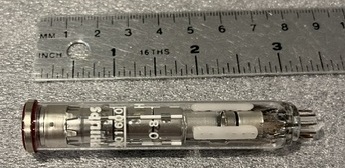
The Philips XQ1600 is a compact 1/2-inch Vidicon camera tube, one of the most widely used imaging tubes of the 1960s-1980s. Designed for industrial, educational, surveillance, and portable video applications, it offered good sensitivity, low lag, and rugged construction in a small package. In the MicroBasement, the XQ1600 represents the practical, everyday side of vidicon technology - the tube that powered countless CCTV cameras, factory inspection systems, and early home video equipment. This write-up covers the history of Philips, the XQ1600 tube, its function, specifications, time period of use, supporting circuitry, and legacy.
Philips (Koninklijke Philips N.V.) was founded in 1891 in Eindhoven, Netherlands, by Gerard Philips and his father Frederik Philips as a light bulb manufacturer. By the 1920s, Philips expanded into radios, vacuum tubes, and electronics. During WWII, Philips produced tubes and components for both sides under occupation. Post-war, Philips became a leader in television, camera tubes, and consumer electronics. The company invented the Plumbicon tube in 1963 and produced millions of Vidicons, Plumbicons, and other imaging tubes. Philips dominated the European and global market for broadcast and industrial camera tubes through the 1980s. Tube production ended in the 1990s as solid-state sensors took over.
The XQ1600 is a 1/2-inch Vidicon camera tube with a photoconductive target (antimony trisulfide or similar). It was designed for compact, low-power applications where size and reliability were critical. The tube is short and thin, with a glass envelope, a 1/2-inch diameter faceplate, and an 8-pin miniature base. It was used in thousands of industrial CCTV cameras, medical imaging, and early portable video systems.
The XQ1600 operates on the photoconductive principle:
Key specifications include:
It was prized for its small size, low power consumption, and reliability in industrial environments.
The XQ1600 was produced and widely used from the mid-1960s through the 1980s. It was a staple in CCTV cameras, industrial inspection systems, medical endoscopes, security cameras, and early portable video equipment. Production continued into the 1990s for replacement parts, but it was largely replaced by CCD sensors in the late 1980s-early 1990s.
The XQ1600 required supporting circuitry typical of Vidicons:
These were housed in compact camera heads or control units. The XQ1600 was easier to drive than larger tubes due to its small size and lower voltage requirements.
The Philips XQ1600 and other 1/2-inch Vidicons powered the explosion of CCTV and industrial video in the 1970s-1980s. They were reliable, affordable, and small enough for widespread use. Today, surviving XQ1600s are collectible for vintage camera restoration and as examples of tube-era imaging technology. In the MicroBasement, the XQ1600 stands as a testament to Philips' engineering prowess - a tiny tube that brought video monitoring to factories, hospitals, and security systems worldwide.