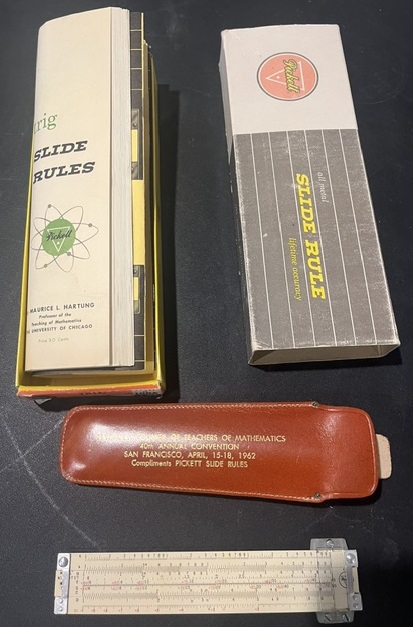
The Pickett TRIG slide rule model N1006-T is a compact, 6-inch pocket-sized trigonometry slide rule produced by Pickett & Eckel (later Pickett Inc.) in the late 1950s. Made from aluminum with a traditional white finish, it was designed for engineers, students, and professionals needing quick trig calculations. In the MicroBasement, the N1006-T exemplifies the precision tools of the pre-calculator era. This write-up covers the history of Pickett, the N1006-T's history, cost, functionality, and legacy.
Pickett & Eckel was founded in 1943 in Alhambra, California, by Ross C. Pickett and Al Eckel. Starting with metal rulers during WWII, they transitioned to slide rules in 1944, pioneering all-aluminum construction for durability and lightness. By 1958, after a split, it became Pickett Inc. Known for "Eye Saver" yellow models and metal bodies, Pickett produced over 10 million slide rules. They supplied NASA - astronauts used Pickett rules during Apollo missions (e.g., Buzz Aldrin's N600-ES sold for $77,675 in 2007). At its peak in the 1960s, Pickett dominated the U.S. market. The company declined with electronic calculators in the 1970s, ceasing production by 1975. Pickett's legacy is in affordable, high-quality tools that powered engineering and space exploration.
The N1006-T was introduced around 1959 as part of Pickett's N-series (new aluminum line with improved cursors and scales). It was a duplex (double-sided) trig model, aimed at students and engineers for portable use. Dated examples from 1959 show it was made in Chicago (briefly after a factory move) or USA. Production ran through the early 1960s, with variants like N1006-ES (Eye Saver yellow). It was popular for its compact size and trig focus, often bundled with instruction manuals like Maurice L. Hartung's "How to Use Trig Slide Rules" (1960).
The N1006-T retailed for $10.95 - $15 in the late 1950s - 1960s (about $110 - $150 in 2026 dollars). It was affordable for students, undercutting wooden competitors. Today, vintage units sell for $20 - $100 on eBay/auctions, depending on condition and accessories like leather cases.
The N1006-T was a 6-inch duplex slide rule with trig emphasis:
It lacked advanced scales but excelled in portability and basic engineering/math tasks.
The N1006-T and Pickett rules bridged manual calculation to the digital age, used in Apollo and everyday engineering. Though obsolete by 1970s calculators, they remain collectibles. In the MicroBasement, the N1006-T highlights how compact tools empowered pre-digital computation.