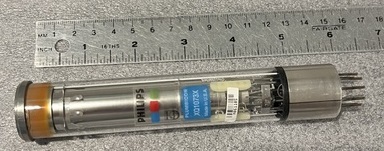
The XQ1073X is a high-performance Plumbicon camera tube developed by Philips in the late 1960s-early 1970s. It was one of the most advanced Plumbicon variants, offering exceptional sensitivity, low lag, high resolution, and excellent color fidelity. In the MicroBasement, the XQ1073X represents the pinnacle of broadcast camera tube technology before the transition to solid-state sensors. This write-up covers what the XQ1073X is, how it worked, the history of Plumbicon tubes, Philips' role, cost, usage, supporting circuitry, time period, and its legacy.
The XQ1073X is a 1-inch Plumbicon camera tube designed for professional color television cameras. It uses a lead oxide (PbO) photoconductive target, giving it superior performance over standard Vidicons and even early Image Orthicons in many applications. The tube is approximately 8-9 inches long with a 1-inch diameter faceplate and was known for its low lag (minimal ghosting), high sensitivity, and accurate color reproduction.
The XQ1073X operates on the photoconductive principle:
The lead oxide target provided much lower lag and better spectral response than antimony trisulfide Vidicon targets. It required magnetic focus and deflection, along with precise target voltage control for optimal performance.
Plumbicon tubes were invented by Philips Research Laboratories in Eindhoven, Netherlands, in 1963. The name combines "plumbum" (Latin for lead) and "icon" (from Iconoscope). The first Plumbicon tubes appeared in 1963-1964, with the XQ1073X becoming a leading model in the late 1960s-1970s. Philips aggressively marketed Plumbicons for broadcast and industrial use, and they quickly became the standard for professional color TV cameras worldwide. The XQ1073X was an advanced version with improved target material and construction for even better performance in low-light and dynamic scenes.
The XQ1073X was a monochrome tube (sensitive across the visible spectrum with strong near-infrared response). In professional color television cameras, it was used in a three-tube RGB configuration. Light entered the lens and was split by a beam-splitter prism (or dichroic mirrors) into three separate paths: one for red, one for green, and one for blue. Each path directed light to its own XQ1073X tube (one for each color channel). The three signals were then processed and combined to form a full-color picture. In some early or lower-cost designs, colored glass filters were placed in front of each tube instead of a prism, but by the 1970s, professional cameras almost exclusively used prism beam-splitters for better light efficiency and color accuracy.
Compared to the RCA Image Orthicon (e.g., 7293A), the XQ1073X offered:
Image Orthicons remained superior in ultimate low-light performance for black-and-white broadcasts until the mid-1960s, but Plumbicons largely replaced them in color studios and portable/field cameras by the early 1970s.
The XQ1073X was a premium broadcast tube, typically costing $800-$1,500 each in the 1970s (roughly $4,000-$7,500 in 2026 dollars). Thousands were used in professional TV cameras by major broadcasters (NBC, BBC, CBS) and manufacturers like Philips, Marconi, Thomson, and Ikegami. A single color camera often used three tubes (one for each RGB channel). They were the standard for studio and outside broadcast (OB) cameras from the late 1960s through the mid-1980s.
The XQ1073X required complex supporting circuitry similar to other Plumbicons:
These were housed in camera control units (CCUs) or built into the camera head. Plumbicons were easier to drive than Image Orthicons due to lower voltage requirements and simpler electronics.
The XQ1073X and other Plumbicon tubes were widely used from the late 1960s through the mid-1980s. They dominated professional broadcast cameras until CCD sensors became affordable in the late 1980s-early 1990s.
The XQ1073X and Plumbicon family marked the final evolution of high-quality photoconductive camera tubes before solid-state sensors took over. They powered the golden age of color television, delivering vibrant, low-lag images for live broadcasts worldwide. In the MicroBasement, the XQ1073X is a beautiful example of 1970s tube technology at its peak - sensitive, reliable, and capable of producing broadcast-quality images in demanding conditions.