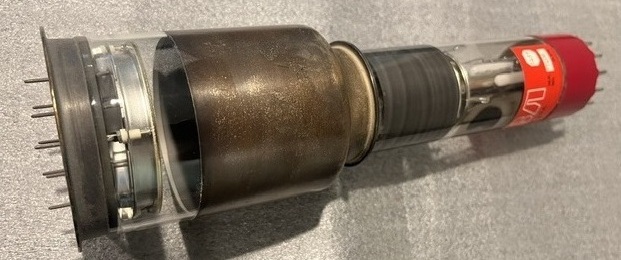
The RCA Radechon 6499 was an early electronic memory technology - a cathode-ray tube (CRT) storage tube that could hold and retrieve binary data as persistent charge patterns on a dielectric target. Developed by RCA in the late 1940s, it served as one of the first practical random-access memory devices before magnetic core memory became dominant. In the MicroBasement collection, this unit was acquired from an obscure Salt Lake City repair shop called "Salt Lake Instrument Service," owned by Bill and Reva Davis. The shop, located on 17th South, specialized in test equipment, oscilloscopes, surplus electronics, and odd repair jobs for local engineers and hobbyists. Bill Davis was widely regarded as a "guru" of vacuum tubes, stocking over 5,000 types and working into his 90s before retiring and closing the business in the fall of 2013 or summer of 2014. This write-up covers the Radechon's history, how it worked, specifications, usage, equivalent storage tubes, production/cost estimates, and the storage technologies that preceded and followed it.
The Radechon was developed by RCA Laboratories in Princeton, New Jersey, with the 6499 variant introduced around 1949-1950. It was an evolution of earlier "Williams tube" concepts (invented by Freddie Williams at Manchester University in 1947). The Radechon was used primarily in early digital computers and radar systems:
It was in use from the late 1940s to mid-1950s, largely replaced by magnetic core memory by 1955 due to higher reliability and density.
The Radechon is a combination of a CRT (for writing) and a camera tube (for reading). It uses a dielectric-coated target inside a vacuum tube. The process works as follows:
This dual-gun design (write gun + read gun) allowed non-destructive read, though repeated reads could degrade the pattern.
Key specs of the RCA 6499 Radechon:
Contemporary storage tubes included:
Typical setup: - Write: High-velocity beam modulated by data signal; deflection circuits scan the target in a raster. - Read: Low-velocity beam scans; secondary electron current collected and amplified to video signal. - Dual-gun tube: Separate write and read guns; deflection yokes synchronized. - Refresh: Periodic write-back of read data to prevent fade. - Interface: Analog video output for reading; digital input for writing.
Production numbers are not well documented but estimated in the low thousands (primarily for military/research). Cost per tube was high - $500-$2000 in 1950s dollars (about $6,000-$25,000 today), due to complexity and low volume. Commercial availability was limited; most went to defense contractors and universities.
Before: Delay-line memory (mercury/acoustic), electrostatic storage (Williams tube precursor), punched cards/tape, magnetic drums.
After: Magnetic core memory (1950s-1970s), drum memory, early semiconductor RAM (1970s), magnetic tape/disk, modern DRAM (1980s+).
The Radechon 6499 was a pioneering step in electronic memory, bridging vacuum-tube computers to solid-state. Though short-lived, it proved random-access storage was possible without mechanical parts. In the MicroBasement, acquired from Salt Lake Instrument Service (Bill and Reva Davis's shop), it demonstrates early memory innovation and the rapid evolution of computing technology.