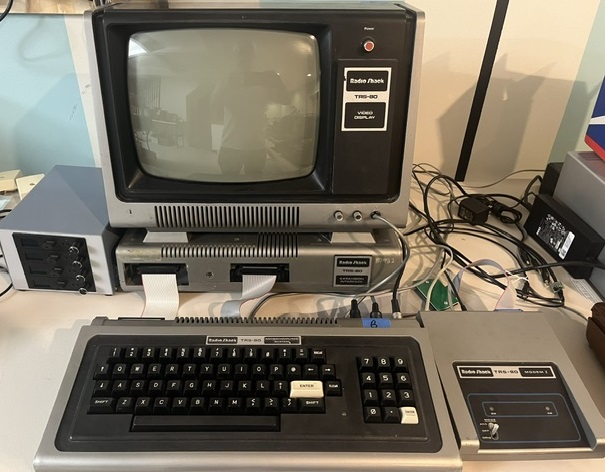
The TRS-80 Model I Level 2, introduced in late 1977 and becoming standard by 1978, represented the mature and most popular configuration of Radio Shack's groundbreaking TRS-80 microcomputer. As one of the "1977 Trinity" of pre-assembled personal computers (alongside the Apple II and Commodore PET), the TRS-80 Model I helped bring computing to homes, schools, and small businesses through widespread availability in Radio Shack stores.
The TRS-80 was conceived by Don French, a Radio Shack buyer inspired by early microcomputers, and designed by Steve Leininger, a talented engineer hired from the Homebrew Computer Club. With a development budget under $150,000, the team created an affordable, ready-to-use system powered by the Zilog Z80 microprocessor. The name "TRS-80" combined Tandy Radio Shack with the Z80 CPU.
Announced on August 3, 1977, the initial TRS-80 shipped with 4 KB RAM and Level I BASIC. Due to strong demand and the need for more capable software, Radio Shack quickly licensed a 12 KB Microsoft BASIC, releasing it as Level II. Early Level I owners could upgrade via a ROM kit, while new units shipped with Level II, 16 KB RAM, and an added numeric keypad. Priced around $999 with monitor and cassette (later dropping), it sold hundreds of thousands of units, far exceeding expectations.
The TRS-80 Model I Level 2 used the Zilog Z80 8-bit microprocessor. Key features included:
The base system integrated the keyboard/computer unit, monitor, and cassette recorder for program storage.
Level II BASIC offered floating-point math, advanced string handling, PEEK/POKE, PRINT USING, and more—vastly superior to the initial 4 KB integer-only Level I. With the Expansion Interface and TRSDOS, users accessed disk-based software, including games, word processors, spreadsheets (like VisiCalc), and programming tools. A thriving third-party ecosystem emerged, with magazines and user groups supporting modifications.
The TRS-80 Model I Level 2 democratized personal computing, selling over 250,000 units and dominating the market in its early years. Its success spurred the home computer boom, inspired clones and competitors, and introduced millions to programming. Production ended around 1981 due to FCC regulations, succeeded by the Model III. Today, surviving units are cherished by retro enthusiasts, symbolizing the accessible, revolutionary spirit of 1970s microcomputing.