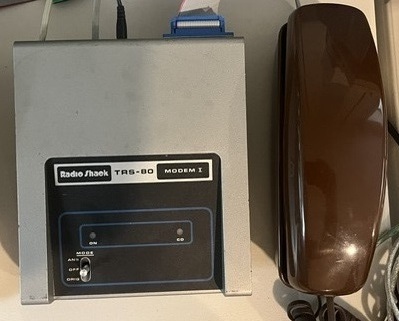
The TRS-80 Modem I was Radio Shack's first modem for the TRS-80 Model I computer, released in 1979. This 300 baud direct-connect modem allowed TRS-80 users to access online services, bulletin boards, and remote computers. It was a key peripheral during the early microcomputer era, enabling the TRS-80 to join the growing world of data communications. In the MicroBasement, it represents Radio Shack's commitment to expanding the TRS-80 ecosystem. This write-up covers the modem's history, specifications, significance, software, and legacy.
Radio Shack introduced the TRS-80 Modem I in 1979 as part of its aggressive expansion of accessories for the TRS-80 Model I (1977). Priced at $149, it was one of the first affordable direct-connect modems for home computers, taking advantage of the 1976 FCC Part 68 deregulation that allowed non-Bell devices to connect electrically to phone lines. The modem was designed to work with the TRS-80's cassette port and expansion interface, making it accessible to the large TRS-80 user base. It was followed by the Modem II (1980) and higher-speed models in the 1980s.
The Modem I was a 300 baud, direct-connect modem with these key features:
It supported basic terminal emulation and was compatible with most TRS-80 software.
The TRS-80 Model I was one of the first mass-market personal computers, selling over 250,000 units. The Modem I made it a true communication device, allowing users to access CompuServe, The Source, and early BBSs. It helped transform the TRS-80 from a hobby machine into a tool for online services, file transfer, and remote computing. The modem's direct-connect design (post-FCC deregulation) eliminated the noise and unreliability of acoustic couplers, making it more practical for everyday use.
The Modem I worked with several terminal programs for the TRS-80:
Software was loaded from cassette or floppy, enabling BBS logins and data exchange at 300 baud.
The TRS-80 Modem I brought affordable online access to thousands of TRS-80 owners, helping popularize BBSs and commercial services like CompuServe. It was part of Radio Shack's ecosystem that made computing accessible. In the MicroBasement, it demonstrates how early modems transformed personal computers into connected devices, paving the way for modern internet access.