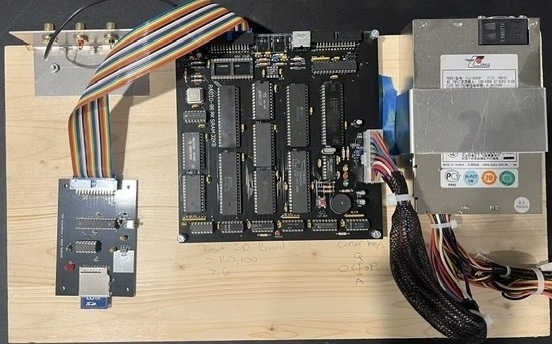
The RADIO-86RK (Radio-86RK) is a classic Soviet 8-bit microcomputer from the mid-1980s, designed as a DIY project for hobbyists. Published in the popular Radio magazine, it became one of the most successful homebrew computers in the USSR, built by thousands using locally available parts. In the MicroBasement, the RADIO-86RK is a modern replica with 32 KB SRAM, built on a newly designed board for reliability and easier construction while preserving the original architecture and software compatibility. This write-up covers the history, creator, publication, architecture, chips, software ecosystem, estimated numbers built, and the modern version in the MicroBasement.
The RADIO-86RK was designed by Sergey Zhavoronkov and first published in the Soviet magazine Radio in 1986 (issues 6-12). The project was a response to the growing interest in personal computers in the USSR, where Western machines like the ZX Spectrum or IBM PC were expensive or unavailable due to import restrictions and economic conditions. Radio magazine printed the complete schematic, parts list, assembly instructions, and a full 8 KB monitor/BASIC listing across several issues. The name "86RK" stands for "1986 Radio Computer." It became one of the most successful DIY computers in the Soviet Union, inspiring a large community of builders, programmers, and software authors.
The RADIO-86RK was built around a KR580VM80A CPU (Soviet clone of the Intel 8080) running at 1.78 MHz (16 MHz crystal divided by 9). It had:
Key chips included the KR580VM80A CPU, KR580VG75 (Intel 8275 equivalent) CRT controller, KR580VT57 (Intel 8257 equivalent) DMA controller, two KR580VV55A (Intel 8255A) PPIs (one for keyboard/cassette I/O, one for extension port), KR580VI53 timer, and 1 KB ROM for font/character generator. Video was generated entirely in software with hardware assistance from the VG75, making the machine very low-cost. The computer typically consisted of 2 or 3 PCBs: mainboard, keyboard, and keypad.
The RADIO-86RK came with a built-in monitor and BASIC interpreter in ROM. Hundreds of programs were written for it, including games (Tetris clones, text adventures, chess), utilities (editors, assemblers, file managers), educational software, and demos. Radio magazine published many of these as type-in listings, and users shared cassettes through clubs, schools, and mail. Popular software included:
Software was stored on audio cassette tape at 1200 baud using a simple interface — programs were saved/loaded as audio tones on standard cassette recorders. No floppy disks or hard drives were standard, though some expansions added disk controllers. The BASIC was compatible with other Soviet 8080/Z80 machines, allowing some porting of software.
Radio magazine published everything needed to build the computer:
Later issues and follow-up articles included expansions (RAM, sound, disk interface) and software libraries. The magazine created a strong community of builders who shared modifications and programs.
Exact numbers are not known, but estimates suggest 10,000 to 20,000 RADIO-86RK computers were built, mostly in the Soviet Union (Russia, Ukraine, Belarus, etc.). This made it one of the most successful DIY computers in the USSR. Many were built from magazine plans or kits, with some later clones and variants produced in small numbers.
The RADIO-86RK in the MicroBasement is a modern replica with 32 KB SRAM for reliability, built on a newly designed board. It uses a modern keyboard instead of the original matrix. The core architecture, KR580VM80A CPU, memory map, and software remain identical to the 1986 design, allowing period-correct software to run perfectly. This replica keeps the DIY spirit alive while making the machine practical for today's use and demonstration.
The RADIO-86RK showed that a simple, low-cost computer could be built at home and still run useful software, even in a country with limited access to Western technology. It fostered a generation of Soviet programmers and engineers during the late Soviet era. In the MicroBasement, it stands as a tribute to the ingenuity of DIY computing — a reminder that with schematics, soldering skills, and determination, anyone can build their own computer.