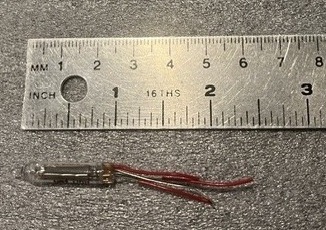
The Raytheon 6977 (also known as DM160 in Philips/Mullard nomenclature, or IV-15 in Soviet equivalents) is one of the smallest vacuum fluorescent indicator tubes ever produced. This tiny subminiature triode was designed as a visual status indicator for transistorized computers and business machines in the late 1950s-early 1960s. In the MicroBasement, the 6977 is a rare gem - a true vacuum tube so small it rivals early transistors, yet still capable of producing a bright blue-green glow. This write-up covers the history of Raytheon, the 6977 tube, its function, specifications, time period of use, and legacy.
Raytheon was founded in 1922 in Cambridge, Massachusetts, as the American Appliance Company, initially producing rectifiers and vacuum tubes. It grew rapidly during WWII, producing magnetrons for radar and millions of tubes for military radios. Post-war, Raytheon became a leader in subminiature tubes for portable military gear and early electronics. The company also pioneered semiconductors and microwave technology. Raytheon remained a major defense and electronics contractor until mergers in the 1990s-2000s (now part of RTX Corporation). Its subminiature tubes are prized by collectors for their rarity and engineering ingenuity.
The 6977 is a filamentary high-vacuum subminiature indicator triode - essentially a miniature vacuum fluorescent display (VFD) element. It consists of a filament, grid, and a phosphor-coated anode that glows bright blue-green when current flows. The tube is extremely small, with flying leads for direct soldering onto printed circuit boards. It was designed to replace neon lamps in early digital equipment because it could produce a variable-intensity glow proportional to anode current and mounted flat on PCBs. The Soviet IV-15 is a direct functional equivalent.
The 6977 was used as a visual status indicator in transistorized computers, flip-flop displays, logic state indicators, and business machines. Key specifications include:
It was prized for its low power consumption, high reliability, and ability to work in transistor circuits (low voltage, low current).
The 6977 was produced and widely used from the late 1950s through the 1960s. It was common in early transistor computers, business machines, and military/industrial control systems. Production continued into the 1970s for replacement parts, but it was largely replaced by LEDs and modern vacuum fluorescent displays by the mid-1970s.
The Raytheon 6977 (and equivalents like DM160 and IV-15) is one of the rarest and most sought-after subminiature indicator tubes among collectors. Its tiny size and glowing blue-green display make it a striking display piece. Today, surviving 6977s are prized for retro-computer restorations, boutique electronics, and as a symbol of the brief overlap between vacuum tubes and transistors. In the MicroBasement, it stands as a testament to the miniaturization push of the late 1950s - when vacuum tubes were shrunk to nearly the size of transistors, just before transistors won the race entirely.