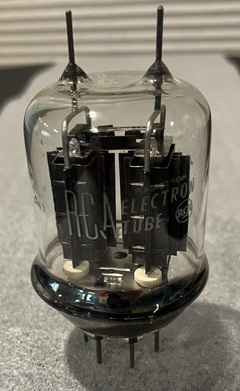
The RCA 3E29 is a high-power dual beam tetrode, designed for RF amplification, modulation, and oscillator service in amateur radio, commercial broadcasting, and industrial applications. Introduced in the 1940s, it was a rugged, reliable tube capable of delivering substantial power at HF and VHF frequencies. In the MicroBasement, the 3E29 represents the post-WWII era of high-power transmitting tubes - a workhorse for linear amplifiers and modulators that could push kilowatts with good linearity. This write-up covers the tube's history, function, specifications, typical use, and legacy.
RCA (Radio Corporation of America) was the leading U.S. tube manufacturer from the 1920s through the 1970s. The 3E29 was developed during World War II as a high-power tetrode for military and commercial RF applications, later released for civilian use in the late 1940s. It was an evolution of earlier RCA tetrodes (e.g., 4-125A, 4-250A) but optimized for higher power and better performance in VHF service. Production continued into the 1980s, and NOS tubes are still available today for restorers and high-power hams.
The 3E29 is a beam power tetrode designed for RF power amplification and modulation. It features a thoriated-tungsten filament for long life and low heater power, and a high plate dissipation rating. Key specifications include:
It was prized for its high power handling, good linearity in SSB service, and rugged construction, especially in VHF applications.
The 3E29 was widely used in:
It was often paired in push-pull configurations for higher power or used singly in medium-power rigs. Many classic ham amplifiers (e.g., homebrew or commercial) relied on the 3E29 for kilowatt output in HF and VHF service.
The RCA 3E29 is one of the most revered high-power transmitting tubes among vintage radio enthusiasts and restorers. Its combination of power, linearity, and reliability made it a favorite for decades. Today, NOS tubes command high prices ($200-$600 each in good condition), and working amplifiers using 3E29s are still in use by hams worldwide. In the MicroBasement, it stands as a testament to the golden age of high-power tube RF - a tube that could push kilowatts across continents (or into VHF) with nothing more than a few watts of drive and a good antenna.