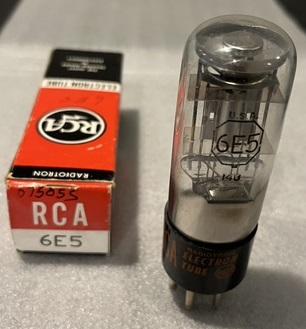
The RCA 6E5, commonly known as the "magic eye" or "cat's eye" tube, was a vacuum tube used as a visual tuning indicator in radios, tape recorders, and other audio equipment. It functioned much like a meter, displaying signal strength through a glowing "eye" that opened or closed based on input voltage. In the MicroBasement, the 6E5 represents a charming piece of pre-solid-state display technology, blending electronics with visual feedback. This write-up covers the history of RCA, the 6E5 tube itself, how it worked, uses, its relevant time period, what displaced it, and its legacy.
RCA (Radio Corporation of America) was founded in 1919 as a patent trust owned by General Electric, Westinghouse, and AT&T to control U.S. radio technology. It became independent in 1932 and dominated consumer electronics through the mid-20th century. RCA pioneered radio, TV, and vacuum tubes, inventing the superheterodyne receiver (1918) and color TV (1950s). At its peak in the 1960s-1970s, RCA employed 85,000 people and held thousands of patents. Acquired by GE in 1986, its brands live on (e.g., RCA TVs by TCL). RCA's tube division produced millions of vacuum tubes, including the 6E5, during the "golden age" of radio.
The 6E5 was introduced by RCA in 1935 as part of its line of tuning indicator tubes. It was a triode with a built-in fluorescent target that glowed green when excited by electrons. The "eye" effect came from a shadow cast by a control electrode, which varied with signal strength. Variants like 6U5 and 6G5 had similar designs. The tube was compact (octal base, 1.5" diameter face) and low-power, making it ideal for consumer devices.
The 6E5 combined a triode amplifier and a fluorescent display in one envelope. Input voltage (from radio AGC or audio level) controlled the grid, modulating electron flow to the target. A fan-shaped shadow electrode created the "eye": strong signal = wide open eye (small shadow); weak signal = closed eye (large shadow). The target was coated with zinc orthosilicate phosphor for green glow. It operated on 6V heater and 250V plate voltage, providing visual feedback without mechanical parts.
The 6E5 was used primarily as a tuning indicator in radios, showing optimal station lock-in (wide eye = strong signal). It also served as a level meter in tape recorders, amplifiers, and test equipment, indicating audio levels or voltage. Common in AM/FM radios, shortwave receivers, and hi-fi systems, it added a "magic" visual element to electronics.
The 6E5 was relevant from 1935 to the late 1950s, during the peak of vacuum tube radio production. It was widely used in pre-WWII and post-WWII consumer electronics, with millions produced. By the 1960s, transistor radios reduced demand, and it faded by the 1970s as solid-state tech took over.
The 6E5 was displaced by:
Transistorization made tubes obsolete for consumer use by the mid-1960s.
The 6E5's legacy is in its iconic "magic eye" design, a symbol of vintage radio aesthetics. It inspired retro revivals in audio gear and Nixie clocks. In the MicroBasement, the 6E5 highlights how visual feedback made technology more user-friendly, bridging mechanical meters to digital displays. Though displaced, it remains a collector's favorite for its glowing charm.