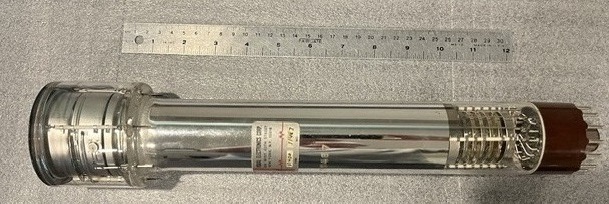
The RCA 7293A is a high-sensitivity Image Orthicon camera tube, one of the most important vacuum tubes in the history of television broadcasting. Used from the late 1940s through the 1960s, it was the workhorse of professional TV cameras, enabling live broadcasts in low-light conditions with excellent picture quality. In the MicroBasement, the 7293A represents the pinnacle of vacuum-tube video technology before the transition to solid-state sensors. This write-up covers what the 7293A is, how it worked, the history of Image Orthicons, RCA's role, cost, usage, supporting circuitry, and its legacy.
The RCA 7293A is a 3-inch Image Orthicon camera tube designed for studio and field television cameras. It converts optical images into electrical video signals using a combination of photoemission and electron scanning. The tube is approximately 15 inches long with a 3-inch diameter faceplate and was known for its high sensitivity and low noise, making it ideal for live television production.
The 7293A operates in several stages:
This design gave the Image Orthicon exceptional sensitivity - it could produce usable pictures with very little light compared to earlier tubes like the Iconoscope.
The Image Orthicon was developed by RCA in the early 1940s under Vladimir Zworykin's team. It was an improvement over the earlier Iconoscope (1930s) and Orthicon (1940). The first practical Image Orthicons appeared in 1946. The 7293A variant became the standard for black-and-white and early color TV cameras from the late 1940s through the 1960s. It was used for many historic broadcasts, including the 1950s-1960s network shows and the Apollo moon landing coverage (though Apollo used a different tube for the lunar surface camera).
RCA (Radio Corporation of America) was the dominant force in early television development. Founded in 1919, RCA pioneered electronic TV, color television (1953), and many key camera tubes. Under leaders like David Sarnoff and Vladimir Zworykin, RCA's labs produced the Iconoscope, Image Orthicon, and Vidicon. RCA manufactured the 7293A at its Lancaster, Pennsylvania tube plant, supplying nearly all major U.S. broadcasters.
The 7293A was an expensive professional tube, typically costing $1,200-$2,000 each in the 1950s-1960s (roughly $12,000-$20,000 in 2026 dollars). Thousands were produced and used in network studios, remote trucks, and military applications. A single studio camera might use three or four tubes (one for each color channel in color cameras). They were fragile and had limited lifespan (hundreds to a few thousand hours), so broadcasters kept large inventories.
The 7293A required complex supporting circuitry:
These were housed in large camera control units (CCUs) and were a major part of early TV studio infrastructure.
The RCA 7293A and other Image Orthicons defined the golden age of live television. They enabled the first coast-to-coast broadcasts, political conventions, and sports events. Though replaced by Vidicons, Plumbicons, and eventually CCD sensors in the 1980s, they remain a symbol of the engineering brilliance of the vacuum-tube era. In the MicroBasement, the 7293A is a rare and impressive artifact of the technology that brought television into American homes.