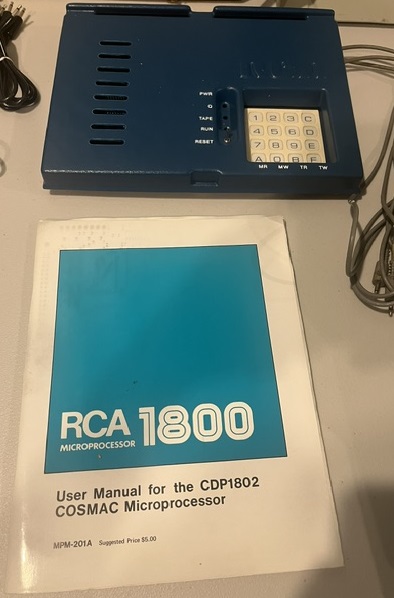
The RCA COSMAC VIP (Video Interface Processor), released in 1977, was an affordable single-board microcomputer kit based on the RCA 1802 CMOS microprocessor. Marketed as a "do-it-yourself" computer for hobbyists, educators, and experimenters, it combined simple hardware with built-in graphics and sound capabilities, making it one of the earliest machines to offer video games out of the box.
The VIP was designed by Joseph A. Weisbecker at RCA's Solid State Division. Weisbecker, an innovative engineer, created the 1802-based "Studio II" game console and championed CMOS for low-power, radiation-hard applications. He developed the VIP (originally called COSMAC ELF) as a personal project to teach his daughter programming, later commercialized by RCA to promote the 1802 CPU.
Introduced in mid-1977 via Popular Electronics magazine (September issue featured build plans), the kit cost $275 (later reduced). RCA sold thousands through ads and electronics retailers. The VIP used off-the-shelf parts, encouraging modifications. Production continued into the early 1980s, with RCA publishing games and expansions in user newsletters.
The VIP centered on the RCA CDP1802 COSMAC microprocessor. Key features included:
Single board design with prototyping area; no full keyboard (add-on or external).
The ROM included CHIP-8—a simple interpreted language/virtual machine for games and graphics. Users entered machine code via keypad or ran CHIP-8 programs (e.g., Pong, Kaleidoscope, Space Invaders clones). RCA published dozens of CHIP-8 games on cassette or in manuals. Hobbyists added Tiny BASIC, assemblers, and video mods. The 1802's unique architecture (16 registers, DMA video) made it fun for low-level experiments.
The VIP brought video games and graphics to hobbyists at low cost, predating many home computers. Its CMOS CPU's low power and radiation tolerance led to space uses (e.g., Galileo spacecraft). The CHIP-8 system influenced modern emulators and retro game platforms (e.g., Octo IDE). While not a commercial blockbuster, its educational value and expandability inspired many. Surviving VIPs are collectible, with active communities recreating CHIP-8 games and building expansions (e.g., color video, SD storage). The COSMAC VIP embodies the DIY spirit of 1970s microcomputing and RCA's innovative 1802 legacy.