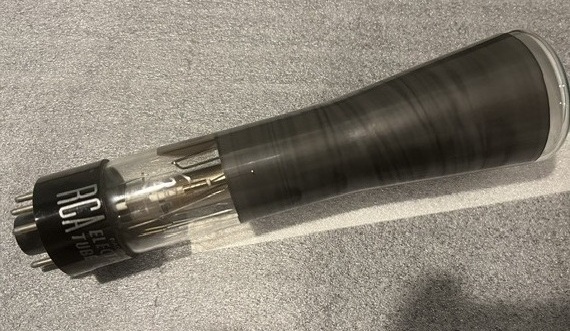
The RCA 2BP1 is a miniature 2-inch cathode ray tube (CRT) designed for use as a small oscilloscope display, tuning indicator, or monitor in portable instruments and radios. Introduced in the late 1930s-early 1940s, it was one of the smallest CRTs available at the time, making it ideal for compact test equipment and early television experiments. In the MicroBasement, the 2BP1 represents the early miniaturization of CRT technology - a tiny tube that brought visual waveform display to engineers and hobbyists. This write-up covers the history of RCA, the 2BP1 tube, its function, specifications, time period of use, supporting circuitry, and legacy.
Radio Corporation of America (RCA) was founded in 1919 as a patent trust by General Electric, Westinghouse, and AT&T to control radio technology. It became independent in 1932 and dominated consumer electronics through the mid-20th century. RCA pioneered radio, television, and vacuum tubes, inventing the superheterodyne receiver (1918) and color TV (1950s). The company's tube division in Harrison, New Jersey, produced millions of tubes, including the iconic 2BP1 CRT. RCA was acquired by GE in 1986, but its tube legacy lives on in vintage electronics and collector circles.
The 2BP1 is a 2-inch CRT with electrostatic deflection, designed for small oscilloscopes, tuning indicators, and test equipment. It features a green phosphor screen for clear visibility and a compact glass envelope with an 8-pin miniature base. The tube is small (about 2 inches diameter x 5 inches long) and was known for its sharp focus, low power consumption, and portability in early instruments.
The 2BP1 functions as a small CRT display, converting electrical signals into visual patterns on a phosphor screen. An electron gun fires a beam modulated by input signals, deflected by plates to trace waveforms, bar graphs, or tuning indicators. Key specifications include:
It was prized for its small size and ability to display simple waveforms or tuning indicators in portable devices.
The RCA 2BP1 was produced and widely used from the late 1930s through the 1950s. It was common in portable oscilloscopes, radio tuning indicators, signal tracers, multimeters with visual displays, and early television test equipment. Production continued into the 1960s for replacement parts, but it was largely replaced by larger CRTs and solid-state displays in the 1960s.
The 2BP1 required supporting circuitry typical of small CRTs:
These were housed in compact instrument chassis. The 2BP1 was relatively simple to drive, making it popular for hobbyist and portable test gear.
The RCA 2BP1 is a collector's favorite among vintage CRT enthusiasts. Its small size and green phosphor screen made it iconic in early portable scopes and tuning eyes. Today, surviving 2BP1s are sought after for restoration of 1940s-1950s test equipment and as examples of tube-era miniaturization. In the MicroBasement, it stands as a testament to RCA's engineering excellence - a tiny CRT that brought visual signal display to the masses in the pre-digital era.