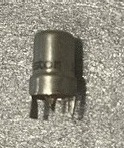
The RCA 6CW4 is a high-frequency Nuvistor triode vacuum tube, part of RCA's revolutionary Nuvistor line introduced in the late 1950s. It was designed for VHF/UHF applications and became one of the most successful Nuvistors due to its excellent performance in TV tuners and communications equipment. In the MicroBasement, the 6CW4 represents the peak of vacuum tube miniaturization and reliability before transistors fully took over high-frequency amplification. This write-up covers the history of RCA and Nuvistors, the 6CW4 tube, its function, specifications, time period of use, and legacy.
RCA (Radio Corporation of America) dominated vacuum tube development from the 1920s through the 1960s. In 1959, RCA introduced the Nuvistor line - a new type of metal-ceramic vacuum tube with a unique cylindrical structure, no glass envelope, and extreme ruggedness. Nuvistors were smaller, more reliable, and better performing than conventional glass tubes, especially at high frequencies. The 6CW4 was one of the first and most popular Nuvistors, used in millions of TV tuners and other RF circuits. RCA's Nuvistor factory in Harrison, New Jersey, produced them in huge quantities until the early 1970s.
The 6CW4 is a high-mu, high-frequency triode Nuvistor with a metal-ceramic envelope and a unique coaxial structure. It was designed for RF amplification in VHF/UHF television tuners, FM receivers, and communications equipment. The tube is tiny (about 0.7 inches in diameter and 1.5 inches long) and extremely rugged, withstanding shock, vibration, and temperature extremes far better than glass tubes.
The 6CW4 was primarily used as a low-noise RF amplifier and mixer in television and radio tuners. Key specifications include:
It was prized for its low noise, high gain, and stability at high frequencies.
The 6CW4 was produced and widely used from 1959 through the 1970s. It was the standard RF amplifier tube in U.S. television tuners (both black-and-white and early color sets) and many FM radios, communications receivers, and early satellite ground stations. Production continued into the late 1970s for replacement parts, but it was largely replaced by transistors and FETs by the mid-1970s.
The RCA 6CW4 and other Nuvistors were among the last great vacuum tubes - they outperformed glass tubes in high-frequency applications and were far more reliable. They are highly sought after today by collectors, audiophiles (for their clean sound in preamps), and vintage TV restorers. In the MicroBasement, the 6CW4 stands as a symbol of RCA's engineering excellence - a tiny, rugged tube that helped bridge the gap between vacuum tubes and transistors in the high-frequency world.