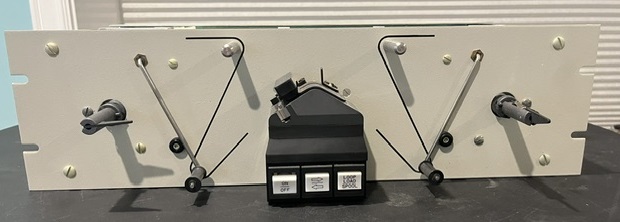
The Ex-Cell-O Corporation (Remex Division) Model RRs7155BA1/660/G-A/U000 is a rack-mount paper tape reader from the 1970s, designed for reading punched paper tapes in computing and industrial applications. This 6-inch rack-mount unit (RR series) was part of Remex's line of data peripherals, known for reliability in harsh environments. In the MicroBasement collection, it is used to load software like Microsoft BASIC on an Altair 8800 and Scelbal on a Mark-8, demonstrating early data input methods. This write-up covers the company history, the model details, and the broader role of paper tape in computing and CNC machines.
Ex-Cell-O Corporation was an American manufacturer of machinery and machine tools, founded in 1919 by a group of tool and die makers in Highland Park, Michigan - all former Ford Motor Company employees. Initially named Ex-Cell-O Tool & Manufacturing Co., it specialized in precision parts for aircraft, grinding machines, and air-driven spindles. The company name changed to Ex-Cell-O Aircraft & Tool Corp. in 1927 and Ex-Cell-O Corp. in 1937 after a reorganization. It expanded through acquisitions, including Robbins Engineering Co. (1948, magnetic chucks), Bryant Chucking Grinder Co. (1958, production grinders), Micromatic Hone Corp. (1963, honing machines), and Greenlee Brothers & Co. (1968, woodworking machinery).
The Remex Division was Ex-Cell-O's data storage peripherals arm, focusing on punched tape readers, punches, and related equipment for computers and industrial controls. Remex products were widely used in the 1960s-1980s for data entry in minicomputers, CNC machines, and teletype systems. In 1986, Ex-Cell-O was acquired by Textron for $1.1 billion (about $3.1 billion in 2026 dollars), becoming a subsidiary. The machine tools division continued as Ex-Cell-O Machine Tools, Inc., until operations ceased in 2006, with layoffs starting April 28, 2006. Parts and service for some lines were supported by companies like Kenrie, Inc., but Remex peripherals are now vintage collectibles.
The RRs7155BA1/660/G-A/U000 is a high-speed, rack-mount paper tape reader from Remex's RR series (likely "Remex Reader"). While specific details on this exact variant are scarce, it is similar to the RRS7300 series, designed for reading standard 8-track (1-inch wide) punched paper tapes. These readers were built for industrial reliability, with features like optical sensing and robust mechanics. Key specifications based on similar Remex models include:
Manuals for similar models (e.g., RRS7300) describe maintenance like cleaning optical sensors and adjusting tape tension. This model was used in data processing, minicomputer loading, and industrial automation.
Paper tape, or punched tape, was a staple storage medium from the 1940s to 1980s, predating floppy disks and magnetic tape. Invented in the 19th century for telegraphs (e.g., Baudot code), it became widespread in computing after WWII. Holes punched in 5-8 level tape represented binary data, read optically or mechanically. In computing, paper tape loaded programs into early machines like the ENIAC (1945), PDP-8 (1965), and Altair 8800 (1975). It was cheap, durable, and portable - billions of feet produced. In CNC machines, paper tape stored part programs (G-code) for mills, lathes, and punches, enabling automated manufacturing from the 1950s (e.g., MIT Servomechanisms Lab's Numeric Control). Companies like Remex supplied readers for both sectors. By the 1980s, floppy disks replaced tape, but it remains iconic in vintage computing.
In the MicroBasement collection, the RRs7155BA1/660/G-A/U000 reads punched tapes to load software on early micros. It interfaces with the Altair 8800 to bootstrap Microsoft BASIC (1975) and with the Mark-8 to run Scelbal (1974 BASIC interpreter). This demonstrates paper tape's role as a primary input method before disks, allowing authentic recreations of 1970s workflows.
Paper tape readers like the Remex model bridged mechanical and digital eras, enabling widespread computing and automation. From Ex-Cell-O's industrial roots to CNC and microcomputers, they highlight how simple media revolutionized technology. Today, vintage enthusiasts preserve them for historical demos, with modern recreations using laser cutters for tape punching.